
Perhaps plackets do not come up much in conversation, nor are they a standalone trend. However, they are an important part of a garment, as they provide both function and structure. The function of a placket that holds fasteners is to secure the opening and help reinforce the fabric to prevent it from tearing or stretching. Plackets can also add structure, style to a garment, and are an important part of the woven category.
2026 Woven Shirt Trends: Modern Updates to Classic Placket Design
For 2026, the style of plackets will not deviate too far from those in previous years. That said, there are some updates to watch.
“Plackets and wovens remain a cornerstone of the fashion and apparel industry, consistently valued for their versatility and timelessness,” said Amy Carton, director of brand management and merchandising with SanMar. “Looking ahead to 2026, we continue to see a shift to new innovative fabric blends, lighter weight and silhouettes suited for a range of environments.”
“We are seeing more placket design details transition to other categories like sweaters and polos,” added Nicolette Dykstra, director of merchandising and product development with Edwards Garment. “Plackets will always remain an integral part of the woven category.”

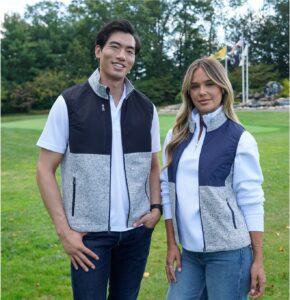
The Summit Sweater Fleece Blocked Vest combines lightweight insulation with soft heathered fleece for versatile warmth on and off the course. Photo courtesy of Vantage Apparel
Lauren Monnier, director of merchandising with Vantage Apparel, said that while standard plackets will never go out of style, what we can expect for 2026 is a minimalist, or more “hidden” seamless aesthetic. “You might see more metal and ornate buttons, just to elevate the piece outside of standard dyed-to- match buttons, with a little more pizzazz,” Monnier said.
Along these same lines, Rob Watson, CEO of Vantage, noted how the left chest is the “holy grai”’ or the real estate for decoration placement. “For logos to pop, that minimalistic, tone on tone monochromatic look allows what we put on the left chest for branding allows it to stand out more.”
Carton added that as workplace attire continues to evolve, hybrid dressing, which she described as “…blending the polish of classic style with the practicality and comfort demanded by modern lifestyle,” will also still be important.
For example, Carton said, SanMar will be introducing a new dress shirt polo featuring a traditional dress shirt collar with the ease of a knit fabric. “Additionally, expect to see subtle design updates like curved hems, notched sleeves, open plackets for women, and ruffle details on women’s wovens.”
“Plackets and wovens are steadily gaining popularity because customers are looking for garments that balance comfort and a polished look,” agreed Jose Miguel García Botello, executive manager of YazbekUSA. “By 2026, I anticipate a continued growth in polos and woven shirts, especially as businesses, schools, and organizations move toward more versatile apparel that works both casually and in professional settings.”
Specifically, Botello said, “For plackets, we expect cleaner silhouettes, performance fabrics, and subtle details like contrast plackets or minimal branding. With wovens, lightweight blends and relaxed fits will continue trending, especially with untucked options that still look sharp in corporate or casual environments. It gives a more relaxed, yet professional appearance.”
In this same vein, Dykstra noted how the untucked trend remainsl popular, particularly within the corporate space. “We see them merchandised with casual bottoms like dark denim, performance pants, and layered with a vest, sweater, and even more of a structured blazer,” she said.
Hybrid Workwear Trends: Where Fashion and Performance Wovens Meet
Digging a little deeper, fashion plays an especially large role in the wovens category. “Wovens are one of the most visible parts of your outfit, especially in professional and semi-professional settings. End users want visibility, and fashion detail is what makes a woven shirt feel new instead of just another button down,” said Dykstra.
Botello agreed that fashion is very important because these apparel categories are no longer seen as just uniforms. Rather, he said, “Consumers want stylish options that they can wear in multiple contexts—at work, events, or socially. That drives purchasing decisions.”
Similarly, Watson said that there is a blend now between fashion and comfort rather than styles being strictly fashion-focused; if something is fashion-worthy, it must also be super comfortable and withstand repeated washings.
Athleisure, Botello said, will also have a big influence. “Stretch fabrics, lightweight performance blends, and hybrid styles will merge the comfort of sportswear with the sharpness of wovens and polos, making them ideal for all-day wear.”
Carton agreed that athleisure and performance apparel will be prominent segments in the market, across both high-end and mass-market retailers.
“Garments featuring lightweight, comfort-focused, and soft fabrics, designed for greater mobility, are increasingly combined with features such as moisture-wicking, anti-odor properties, and UPF 30 protection,” she said. “These versatile styles are especially appealing as they transition seamlessly from work to leisure settings.”
Performance Fabric Trends in Woven Shirts and Polos
In terms of materials, because of its breathability and softness, cotton remains one of the most common woven fabrics used in both casual and dress shirts that feature plackets. Polyester, being durable and wrinkle-resistant, is also often blended with cotton for performance, is common in uniforms and is used for shirts that need to retain shape and color through frequent washings as well.
“Cotton blends and performance knit wovens are probably some of the [most] popular fabrications in this category,” said Dykstra. “These are known for their durability, soft hand, and wrinkle resistance. They blend function with comfort.”
In terms of the way in which they’re worn, cotton-polyester blends are ideal for everyday-wear garments, like polo shirts and dress shirts, while polyester alone has long been trendy in the performance space due to its moisture-wicking capabilities and resistance to snagging.
“Blends with either cotton or nylon are also gaining traction, as they combine…the softness and breathability of cotton with the strength and flexibility of nylon, resulting in fabrics that offer balanced comfort and performance,” Carton said.
“We’re also seeing more demand for performance fabrics with spandex for stretch, and sustainable blends like organic cotton mixed with recycled polyester,” Botello noted.
Color Trends for 2026 Woven Shirts: Earth Tones, Refined Pastels, Deep Neutrals
According to Dykstra, when it comes to wovens, patterns are still popular, with smaller stripes becoming especially more popular as are small geometric prints.
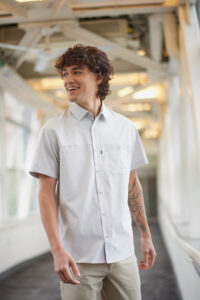
The new recycled Polyester AeroBreeze Pro Shirt, designed to keep you cool and comfortable during the busiest workdays. Photo courtesy of Edwards Garment
For his part, for 2026, Botello said to expect micro-patterns, subtle checks and textures that give depth without being too bold, allowing them to work well in both casual and corporate settings.
As for colors, neutrals like navy, gray and white will always be front and center. However, Botello said there is growing interest in earth tones, pastels and deep greens, and that customers also like seasonal colors, which align with fashion trends.
Along these same lines, Watson said that while black, gray, royal blue, navy blue, and red were the top five colors of all categories of apparel, recent trends are turning toward deeper navies or even cream colors.
For his part Carton said she believes that the color palette for plackets and wovens is poised to expand, due to a resurgence of such earthy neutrals as tans, khakis, sage greens, and clay tones. She also cited the popularity of what she calls “refined pastels” such as pale blue, lavender and blush, which will appeal to those seeking a fresh and elevated twist on traditional dress.
“This balanced spectrum will empower brands and wearers alike to embrace both timeless classics and modern interpretations, creating garments that transition effortlessly between work, leisure, and social occasions,” Carton said.
Relaxed Fit Woven Shirts and Sustainable Apparel Trends for 2026
Moving on to fit, Monnier said the industry is seeing a movement away from tapered or slim fits, such as what we are seeing in bottoms. “Tops and woven shirts have followed suit,” she said. “We are seeing relaxed, baggier fits, with things that you can layer or tie a knot around your waist, versus a specific tailored slim fit shirt.”
As for sustainability, as is the case with pretty much every other apparel category out there, a garments environmental footprint continues to be important for everyone. This includes customers seeking transparency across all steps of the supply chain, which in turn has many companies now responding by incorporating sustainability as an integral part of product development.
More specifically, Dykstra said the industry is seeing growth in the popularity of renewable fabrics and chemical-free technologies, while Botello noted the way his company is moving toward recycled polyester, organic cotton and eco-friendly dyes.
Watson confirmed that most of the industry is concerned about sustainability, from manufacturers to distributors to buyers. In terms of his own company, he noted how Vantage Apparel now has an entire collection made of recycled water bottles. “The way it’s manufactured is almost softer than 100 percent cotton pieces, and we’ve continuously added more products into that sustainability line,” he said. The company also has a give-back component, donating a percentage of sales to an environmental nonprofit.
Marketing Woven Shirts in 2026: Social Media, Influencers and Visual Storytelling
When it comes to marketing, brands that rely on visual storytelling arguably will be the most successful. Because of the demand for transparency in the plackets and wovens apparel category, creating videos showcasing the manufacturing process of how woven fabrics are made or how plackets are constructed is one way to connect with customers. Interactive content is appreciated by younger consumers, and if there is a way to collaborate with influencers or designers on social media, that kind of promotion is invaluable.
In terms of specific platforms, Botello said that social media is most effectively used when creating lifestyle-driven content that shows real people wearing the products in authentic settings. “Video, influencer collaborations, and targeted campaigns on platforms like Instagram and TikTok help connect with younger buyers while LinkedIn works well for corporate sales.”
“Giving these styles exposure and explaining where distributors and companies can utilize these pieces in their apparel program or event business would be an effective use of social and marketing to drive sales in this space,” Dykstra added.
That said, Watson cautioned that because social media is so saturated, consumers are aware if something is an ad versus a real story. For that reason, he said that the more personable a company can make an ad, the more the audience will want to engage with it.
Customization Trends in Corporate and Team Woven Apparel
Moving on to construction details, Botello said to look out for improvements in moisture-wicking fabrics, winkle resistance and stretch technologies. In addition, “Digital printing and embroidery innovations are also allowing more customization at scale, which is key for teamwear and corporate orders.”

Designed for lasting comfort, the Oxford shirts are offered in an array of sleeve lengths and colors. Photo courtesy of Yazbek USA
“New options for plackets include snap closures, overlapping closures, and hidden zippers. As for trends in production and technology we are hearing about automated sewing and computer guided sewing to improve efficiency and consistency,” Dykstra added.
In terms of demand, Plackets and wovens are traditionally associated with shirts and uniforms, of course. However, with some creativity, there are a number of non-traditional markets companies can pivot to as well.
By way of example, Botello said that because their customers value durable, stylish and customizable garments to better represent their brands, corporate uniforms, hospitality, education and sports organizations continue to grow as niches. Other non-traditional markets that continue to see a rise in this in placket demand include golf clubs, yacht clubs, equestrian groups, and fishing competitions. “These communities value premium polos and woven shirts with customization, offering great potential for growth,” Botello said.
“For Edwards, it’s focusing on event-driven business, whether that be a company anniversary, grand opening, customer rewards program or any other one-off event,” said Dykstra. “Wherever a company or group wants to make their brand stand out, there is a place for polos or wovens with plackets to elevate the look and not just the regular T-shirt that everyone else uses.”
Upselling shirts is another way to maximize revenue in this apparel category, especially as margins are often better on polos and wovens than on basic T-shirts. For example, according Botello, “Many groups—like churches, family reunions, or corporate events—are willing to upgrade to embroidered polos because they convey a more unified and premium image. Upselling is effective when we highlight durability, comfort, and the professional look embroidery provides.”
Hilary Daninhirsch is an award-winning freelance writer based in Pittsburgh. Her work has been featured in a number of lifestyle and trade magazines. She can be reached at [email protected] or hilarydaninhirsch.journoportfolio.com.