In Part 1 of a two-part series, the author looks at why decorators feel like they’re continually falling behind despite being as busy as ever. To go to Part 2, click here.
Let’s call this article what it is: a reality check. The decorated apparel industry is not struggling because demand has disappeared. Shops are busy. Orders are coming in. Machines are running.
At the same time, an uncomfortable truth keeps surfacing in conversations across the industry. Despite all this activity, confidence is shaky, margins feel tighter and owners are dealing with more anxiety than they have in years. Those butterflies in your stomach are not accidental. They are the result of businesses designed for one era trying to maintain momentum in a market that has quietly moved on to a different way of thinking.
Toward the end of 2025, I interviewed more than 80 shop owners, suppliers, industry leaders and colleagues for my book “2026 Thinking: How Businesses Will Win, Stall, or Fail in 2026.” The patterns revealed in these discussions are impossible to ignore. Average order sizes are shrinking. Decision cycles are accelerating. Customers expect speed, customization and professional quality simultaneously. Work that once arrived in predictable, high-volume runs now shows up in the form of frequent, smaller orders that must be personalized and are often urgent. The industry did not suddenly forget how to decorate apparel. What broke was the operating model that assumed large, stable runs would continue to carry the business.
This is an identity crisis, not a capability problem. The decorated apparel industry was built around volume, repetition and efficiency at scale. However, customers these days judge shops on responsiveness, information coordination and reliability at the unit-of-one level. When businesses organized around batch thinking try to compete in an on-demand world, friction is the result. Pricing feels risky. Labor feels stretched. Leadership time disappears. Profits never seem to catch up to the extra effort required to pull off daily magic tricks. This article is a wake-up call. Not because the industry is failing, but because it is being forced to level up, whether it is ready to do so or not.

Legacy Production Workflows No Longer Set the Pace
As I was writing my book, shop owner after shop owner talked about how order volume keeps disappearing. The large runs of the past justified rows of automatic screen-printing presses.
Along with these presses came the support structure needed to keep the beast alive, including dedicated production crews, efficient screen rooms, airtight production schedules and workflows centered on piles of shirts all feeding the machine. At any given time, most shops only had about three to five weeks of work booked out, but that was okay. The assumption was the schedule would keep refilling, like a magic well that never runs dry.
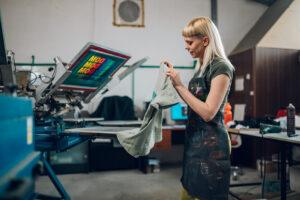
Print-on-demand is not the enemy, but without a clear economic lens through which to view your business, it can leave you feeling exhausted and confused. Image by Zamrznuti tonovi – stock.adobe.com
Granted, that world has not yet vanished entirely. The reality, though, is that it no longer defines the center of gravity for most shops. Large orders still arrive, but less frequently. Worse yet, in addition to being more sporadic, these same orders are often delayed until the last possible moment. They are no longer the dependable backbone of daily operations. Instead of flowing steadily into the shop, they appear in bursts and are now surrounded by dozens or even hundreds of other smaller orders.
Print-on-demand (POD) didn’t replace volume. It changed how volume behaves. The same customer who once ordered 1,000 shirts for an event now has an online store portal and ships their garments directly to the end user through an industry print partner. The unit count might be the same, but the workflow impact is dramatically different. Multiply this out, annualize it, and it results in a dramatic impact on a business’s bottom line.
Since the decorated apparel industry began, we’ve tried to find the best way to get an order, produce it and get it to the customer as quickly as possible. Just from an order-count basis, the ongoing shift to the “unit-of-one” has overwhelmed those shops that still work this way, as more transactions mean more quoting, more art creation and approvals, more touches in receiving and shipping, more production effort and more chances for mistakes. For many shops, this is a profit-draining nightmare.
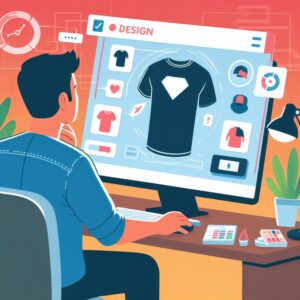
Today’s consumers put a premium on responsiveness, information coordination and reliability at the unit-of-one level. Image by Aisha – stock.adobe.com
The continuing shift explains another trend many of the shop owners I contacted talked about. Automatic screen-printing presses are either being sold off or left underutilized, not because screen printing stopped being a viable technology, but because the work they receive these days no longer shows up in a way that is capable of keeping these machines going. Instead, digital workflows augmented by automation, artificial intelligence and connectivity are being built around direct-to-film (DTF) transfers, direct-to-garment (DTG) and other hybrid production methods that thrive on speed and flexibility.
To be clear, this is not a downgrade. It is an industrial adaptation to how customers buy.
Then there’s the other factor at play: as shops align their business with print-on-demand equipment and workflows, more and more companies are outsourcing their larger print runs to contract decorators. This decision is not an admission of weakness, but a strategic acknowledgment that running two fundamentally different production models under one roof requires more clarity, discipline and capital than many shops want to commit to. For contract decorators, this is good news. For everyone else, it is a sign specialization is accelerating.
Clarity and Identity as a Custom Apparel Decorator
To be clear, the problem here is not volume versus print-on-demand, but the fact all too many shops are still organized as if volume work will continue to reliably dictate the rhythm of their business. When that assumption fails, that’s when the shop starts to feel unstable. Labor planning feels like guesswork, as is evident in the way shops are starting to give production crews three-day weekends. Pricing feels risky. Sales teams start lowering prices to book jobs. Owners and leadership teams start spending more time managing exceptions and less time building for the future.
Bottom line: The industry we built was optimized for predictability. The industry now operates on and rewards adaptability. Until those two realities are reconciled, the tension within shops will continue to manifest as stress, inefficiency and ever-shrinking margins. The result of all these trends is that shops are feeling the tension. The natural reaction, though, is too often look outward. People in the industry share a common refrain:
“Nobody is buying.”
“The market is weird right now.”
“Things will pick up in the spring.”
“Customers are difficult.”
“Labor is expensive. We need to do something.”
“Do I need all of this equipment?”
Granted, all these things may in fact be true. However, it conveniently avoids a harder conversation. Shops that haven’t changed their thinking are still operating under the assumption the “way we’ve always done it” still works financially. This is where the identity crisis becomes expensive.
In a volume-driven world, inefficiencies are easier to hide. Larger runs absorb setup times. Small mistakes are diluted across thousands of units. Labor productivity feels strong as presses stay busy and skids of completed work leave the shipping department. For years, the financial math worked, even when it was fuzzy. Many shops that grew up in this environment learned pricing and production by feel rather than by measurement. As long as volumes kept flowing, the gaps did not matter.
In a unit-of-one world, that safety net disappears. Every touch matters. Every delay, no matter how slight, costs real money. Every exception interrupts workflow. When work arrives fragmented and urgent, labor costs are no longer spread thin; they are concentrated. Shops that never measured their production processes no longer know how to convert their efforts into profit. They feel busy, but are financially stuck.
Apparel Decoration and the Value Per Hour Metric
This is where the idea of “Value Per Hour” comes in. Value Per Hour is not a production metric. It is a leadership metric. It answers a question most shops are uncomfortable asking: “How much revenue does this business generate for every hour they run production?”
The formula is simple:
Value Per Hour = Total Revenue ÷ Total Productive Labor Hours
Productive labor hours in this case represents the time spent actually producing work. This includes running jobs, setups, teardown, job transitions and the labor required to move work through production. Not every paid hour in the shop ends up being productive, which is why understanding how much value is created during these hours becomes so important.
It’s also important to understand what this number represents. Revenue, or value, per hour shows how efficiently production time is being used. It does not by itself determine profitability; however, what it does do is provide a lens for evaluating how work moves through the shop.
Let’s say you ran 10 orders of 24 units on an automatic press at $15 per shirt.
Total Revenue = $3,600
Total Productive Labor Hours = 7.5
Value Per Hour = $3,600 ÷ 7.5 = $480 per hour
Now let’s say that same automatic press worked within the same time frame but printed three orders of 1,000 units instead. We’ll even cut the price per shirt in half to $7.50 each.
Total Revenue = $22,500
Total Productive Labor Hours = 7.5
Value Per Hour = $22,500 ÷ 7.5 = $3,000 per hour
Both scenarios consumed the same amount of production time, but the value created over the course of that time was dramatically different. This is why moving tiny orders to DTF or DTG makes so much sense. When you keep the auto running with larger orders, the shop can generate dramatically more revenue during the same time period.
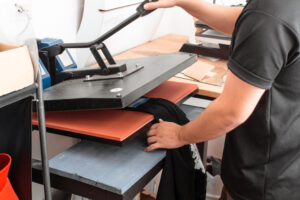
Direct-to-film (DTF) transfers and direct-to-garment (DTG) decorating thrive in the context of ever-shorter runs. Image by Djavan Rodriguez – stock.adobe.com
This underlies the biggest challenge the industry faces right now: too many shops are keeping small orders on their legacy equipment for the sake of making sure their people busy. When sales start drying up, though, pricing becomes guesswork. Scheduling becomes reactive. Sales decisions become emotional. Discounts creep in as a substitute for confidence.
It’s always an eye-opener for me when shop owners say, “We’re just not making the money we used to.” For them, the presses are still running, so things must be okay. Because the schedule is still kind of full, it only makes sense profitability should follow. The problem is they aren’t measuring their production processes properly. They don’t have a firm grasp on their company’s math. The “being busy” signals they’re receiving feel familiar, but those trusted busy signals no longer reflect reality.
Despite growing supply chain costs, these shops aren’t doing a good enough job evaluating their KPIs. They aren’t keeping an eye on pricing the way they should in order to ensure they’re hitting their profit goals. This is why so many shops feel trapped between being busy and being profitable. They’re optimizing motion as opposed to outcomes. They’re protecting activity as opposed to value. Worst of all, they are making decisions on how the work they’re doing “looks,” not the value it produces.
Until a shop clearly understands which types of work protect Value Per Hour and which destroy it, the identity crisis persists. Volume and print-on-demand are not the enemies. But without a clear economic lens in your shop, they will compete for resources, attention, and labor in ways that leave the business exhausted and confused.
The next step is understanding the math behind how work flows through your shop and how different types of jobs affect the value created during each hour of production—two of the things we examine in Part 2 of this series.
Marshall Atkinson is a veteran designer, custom apparel decorator, business coach and principal of Atkinson Consulting, (marshallatkinson.com). He is also the publisher of the “Midjourney: Elevating Print Creativity” online newsletter, covering the latest in generative AI (midjourneyexperience.com). To download a copy of Atkinson’s newly published book “2026 Thinking: How Businesses Will Win, Stall, or Fail in 2026,” free of charge, click here. To see Part 2 of this series, click here.