
While the promotional products industry and decorated apparel have some overlap, for a screen printer, embroiderer or heat-press decorator looking to add promo products to their business, there will invariably be a learning curve. Just as most decorators have spent years learning about apparel fabrics, printability, optional decorating methods, and styles, you will need to learn about a wide range of non-apparel merchandise in many categories.
Of course, all decorators are familiar with tote bags, koozies, water bottles, umbrellas, decals and stickers, due to the fact they’ve had customers ask and have had to find a way to supply them. Now, though you must add in products such as tech gadgets, drinkware, food, phone accessories, writing instruments and corporate gifts.
There’s a lot to know, and as you’re starting out it can be confusing.
“Don’t let all the products overwhelm you,” advises Tom Rauen, president of 1-800-Tshirts.com (1800tshirts.com). “Call up a few of the top suppliers and let them know what your niche is. They might suggest three to five products, and you can focus on getting those out there in the beginning.”

“The key is to start small and be strategic,” agrees Andy Lantzman, a “promotional therapist” with the blank promotional merch and apparel specialist Geiger (geiger.com). “Don’t offer everything to everyone. Instead, use the approach of: Here’s something really cool I’d love to share with you.”
“The most common mistake is believing that because you have access to everything, you need to shop through everything,” says Jeremy Chacon, director of distributor subscribers at PromoEQP (promoeqp.com). “This will lead to an overwhelming death spiral. You do not need to filter through 4,000 promotional product suppliers to find the right item for your client.”
According to Chacon, even veteran promo distributors typically use only 100 to 125 suppliers in the course of a year, with 80 percent of their orders are going to 20 percent of the suppliers they use. This means even highly successful distributors use only about 25 to 30 suppliers a year for the majority of their orders. The trick to simplifying the process is working with suppliers you can trust.
As you learn about specific product categories, this will add to your ability to offer a value-added proposition. “It’s the ability to—off the top of your head—throw out five or six solutions,” Greg Kitson, founder of Mind’s Eye Graphics (decaturchamber.org) says. When a client comes to you for a 10k road race, for example, and they say, “We’ve been giving away water bottles for the past five years, but we’re sick of them. What else have you got?” as a solution provider you should be able to offer some ideas.
With this in mind, Chacon suggests designating someone at your shop as a kind of “promo champion” when dealing with this side of your business. “This is the person who connects with the world of promotional products,” he explains.
Ideally, Chacon says, the promo champion trains the rest of the staff to the degree to a point where they can comfortably present promotional products that match well with an apparel order. Then, if and when more in-depth information is needed, they can get the champion involved. When a shop’s sales team is knowledgeable enough about promo products to regularly suggest them, he add, it can drive up a decorator’s merch revenue to as high as 25 percent of total revenue.
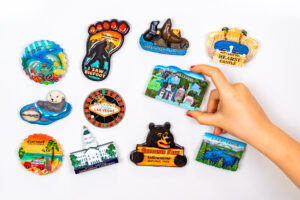
When trying to figure out the kinds of promotional merch that will serve your customers best, imagine where it will get them the most visibility. Image by Olga – stock.adobe.com
Promo Buyer Beware
Another reason to do your homework is to be prepared for larger orders and all that these kinds of orders require. Among other things, you may have to put down a deposit or partial payment, which can be risky if anything falls through or if you quoted your client a price that, when the invoice comes, it has extra charges on it you weren’t aware of.
“A lesson we learned was that with drinkware, like coffee mugs, especially from China, 10 percent breakage is not normal, but it is also not unusual and is considered acceptable by some suppliers,” Kitson says. By way of example, he says, you may have ordered 1,000 units, but you might only get 905 you can sell—and that might still be considered a complete order. “There may be a difference of between 3 percent and 10 percent over or under the actual requisition, and you cannot back order the shorted difference at the same price unless you are willing to pay for another 1,000 units. And if you want guaranteed delivery on 1,000 pieces, you might be charged 3 percent to 18 percent more, which is not the advertised price,” he says.
Pay Attention to Pricing
Another area unfamiliar to apparel decorators will be product pricing codes. These consist of alphanumeric or numeric identifiers representing specific pricing structures or discounts applied to products offered by suppliers in order to 1) help streamline the ordering process and 2) ensure accurate pricing for both the supplier and the customer. Among other things, these price structure codes include different prices for wholesale, bulk and discount orders, special promotions and more. For example, a certain code might represent a 10 percent discount for a certain quantity as opposed to a 12 percent discount for larger orders.
“You need to understand the pricing, so you don’t mislead,” Rick Roth, president, Mirror Image Screen Printing & Embroidery (mirrorimage.com) says. “It may show as nine cents, but maybe the printing setup adds 20 cents. You’ve got to read all of the details.”
The good news is Promotional Products Association International (PPAI—ppai.org) and The Advertising Specialty Institute (ASI—asicentral.com), two organizations anyone and everyone interested in getting into the custom merch business should be sure and get in touch if, will give you all that information. They’re clear about the pricing, what’s covered and what’s not, and what you’re charged for.
“There is almost always a suggested manufacturer’s retail price,” Kitson says, by way of example. “This is what you charge the end user. You need to learn the lingo. For example, that EQP is end-quantity pricing.”
Similarly, something you never want to do is accidentally give your customer your wholesale pricing sheet, i.e., a pricing sheet meant only for distributors. As you might well imagine, it would be hard to imagine a quicker way of complicating a sale, and/or wreaking havoc on your margins!
Getting The Word Out
Finally, when it comes to generating sales, the most obvious way to let your clients know you’re now offering promotional products is by simply telling them the next time they come into your shop for another decorated apparel order. That said, Rauen says he’s also had success with social media and plans to initiate an email campaign with an eye toward increasing sales even further.
“We post on social media and frequently the message is, ‘Did you know we offer this?” Rauen says. “We also try to educate and offer suggestions in our posts. For example, ‘Here’s how you can use this promotional product and how it can be effective for your business.” It’s not just, ‘Here’s a new tchotchke,’ just for the sake of putting it out. For example, as we approached Father’s Day recently, we showed a bamboo BBQ set and customized drinkware to spark ideas,” he adds.
Beyond that, ask yourself these questions: Where are your customers’ customers? What kinds of people are most likely going to need their services? Where might they most likely see the promotional products your customer is thinking of distributing? A great example would be that of an electrician. As it turns out, the number one promo product for this kind of business is a magnet of the kind that invariably gets stuck on the fridge or a fuse panel. When something blows, there’s the phone number!
Another powerful marketing tool is networking, which once established, you can use to increase your reach and business dramatically. Granted this will require an investment in time in order to understand the goals of your connections and stay engaged. But according Lantzman it’s invariably worth it.
By way of example, Lantzman describes how he was at a trade show once and he ran into a customer from just down the street, a gas utility that had a sister company, which was a water utility. Afterward, he called his contact and said, “I’d love it if some of your water utility HR people could stop by the show. It’s two miles from your facility.” Sure enough, the senior vice president of human resources showed up and was knocked over by Lantzman’s quality and selection. “Sometimes, it’s just nudging people and saying, ‘I’ll make it worth your while to listen to me. Many times, that’s what it takes to get in the door,” Lantzman says.
Deborah Sexton is a former editor of Impressions Magazine and now owns her own company, Saracen Communications, doing digital media marketing, copywriting and public relations work for companies in the decorated-apparel industry. You can reach her at [email protected].