In today’s world of print-on-demand, simply investing in more production capacity is no longer the answer
For years, decorated apparel shops built their businesses on a simple formula: land a big order, print it, ship it and then move on to the next job. The model worked…until it didn’t.
Today, many decorators find themselves busier than ever, yet struggling to scale and grow profitably. Orders are smaller. Customers want more options. Personalization is no longer a premium feature; it’s now expected by customers across the board. Whether the customer is a corporate buyer, a school, a franchise or a consumer shopping online at midnight, the expectation is the same: fast, accurate, frictionless fulfillment.
This is where many traditional print shops hit the wall.
The challenge isn’t decoration quality. It isn’t equipment. It isn’t even demand. It’s how work moves through your shop—or more accurately, how it all too often doesn’t.

Over the last decade, I’ve visited dozens of print shops across the United States. I’ve personally worked inside multiple high-volume operations, watched teams have to struggle with manual workflows and seen first-hand how quickly complexity can overwhelm even the best operators. What separates the shops that are scaling from the ones that feel stuck isn’t hustle, people or presses, it’s systems.
Why the ‘Old Ways’ of Custom Decorating No Longer Work
Print On Demand (POD) didn’t just happen overnight. We saw early versions of it nearly a decade ago. For a long time, though, it failed to live up to its promise.
Why? Because most shops tried to layer POD on top of workflows that were never designed for this kind of thing. Worse, yet—and the part that bums me out more than anything—is the fact far too many of the shops I talk these days remain stuck in that same place.
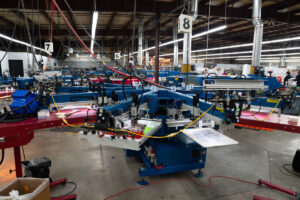
Today’s production software automation makes it possible to run a mix of large and small orders without getting bogged down by a bunch of paperwork. Photo courtesy of STAHLS’/USColorworks
Manual order entry. Email-based artwork approvals. Shared spreadsheets. Tribal knowledge passed from one experienced employee to the next. Limited house inventory because managing too many blanks feels risky. Each and every one of these friction points slows down production and introduces the possibility of errors. Worse yet, it also all too often results in a hesitancy to scale.
In other words, while the “demand” for on-demand, personalized apparel has long been there, the infrastructure to support it hasn’t.
Fast forward to today, and the market has forced the issue. Print-on-demand apparel is now growing in a way traditional bulk decoration simply isn’t. Industry research consistently shows double-digit global growth for POD, while bulk apparel decoration continues to grow slowly and inconsistently by comparison. Even those customers who aren’t abandoning bulk entirely are breaking it up. In a best-case scenario, what used to be a single 10,000-piece one-time order is now five smaller orders spread over the course of an entire year.
At the same time, ecommerce has reshaped customer expectations. Those bulk-only customers of old are now used to convenient ordering, instant order confirmation and increasingly accurate delivery times. They don’t care how complicated your shop floor is. They only care that you get their order right, and that it arrives on time.
This shift has exposed a hard truth for decorators: you can’t scale modern demand with manual or bulk-forward processes.
The Bottleneck Isn’t the Screen-Printing Press
When shops talk about growth constraints, the conversation often turns to things like press capacity or the shop floor. I often hear, “We need another press,” or “We need a faster printer,” or “We need more workers.”
The reality is that most inefficiencies occur long before the ink is mixed or the transfers touch fabric. Instead, they happen:
- at order intake
- during artwork prep
- when jobs are handed off between people without clear instructions
- when shipping labels are created manually at the end of a long day
I’ve seen shops invest heavily in high-capacity equipment only to bottleneck themselves with paper job tickets and email chains. More machines not only won’t fix broken workflows, they often amplify the problem. This is where production software automation enters the conversation, not as a buzzword, but as a necessity.
What Automation Actually Means for Apparel Decorators
Automation isn’t about removing people from the process and replacing them with robots. It’s about removing guesswork.
At its core, production software automation connects the entire lifecycle of an order, from the moment it’s placed to the moment it ships, all into one continuous system. Orders flow instead of slow down. Decisions are made once and then carried through the rest of the process. Operators focus on execution, as opposed to interpretation.
Custom decorator USColorworks serves as a powerful example of this kind of dynamic at scale. As a high-volume contract decorator producing tens of thousands of garments per day, the shop had long since mastered the art of bulk efficiency. When an increasing number of one- and two-piece jobs began coming in, though, the economics of the way USColorworks runs its business had to change as well. As co-founder Rodney McDonald puts it, “If you have to touch a one-piece order manually, you’re losing money.”
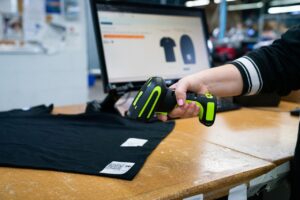
A truly comprehensive production software system allows companies to connect the entire lifecycle of an order, from the moment it’s received to the moment it ships. Photo courtesy of STAHLS’
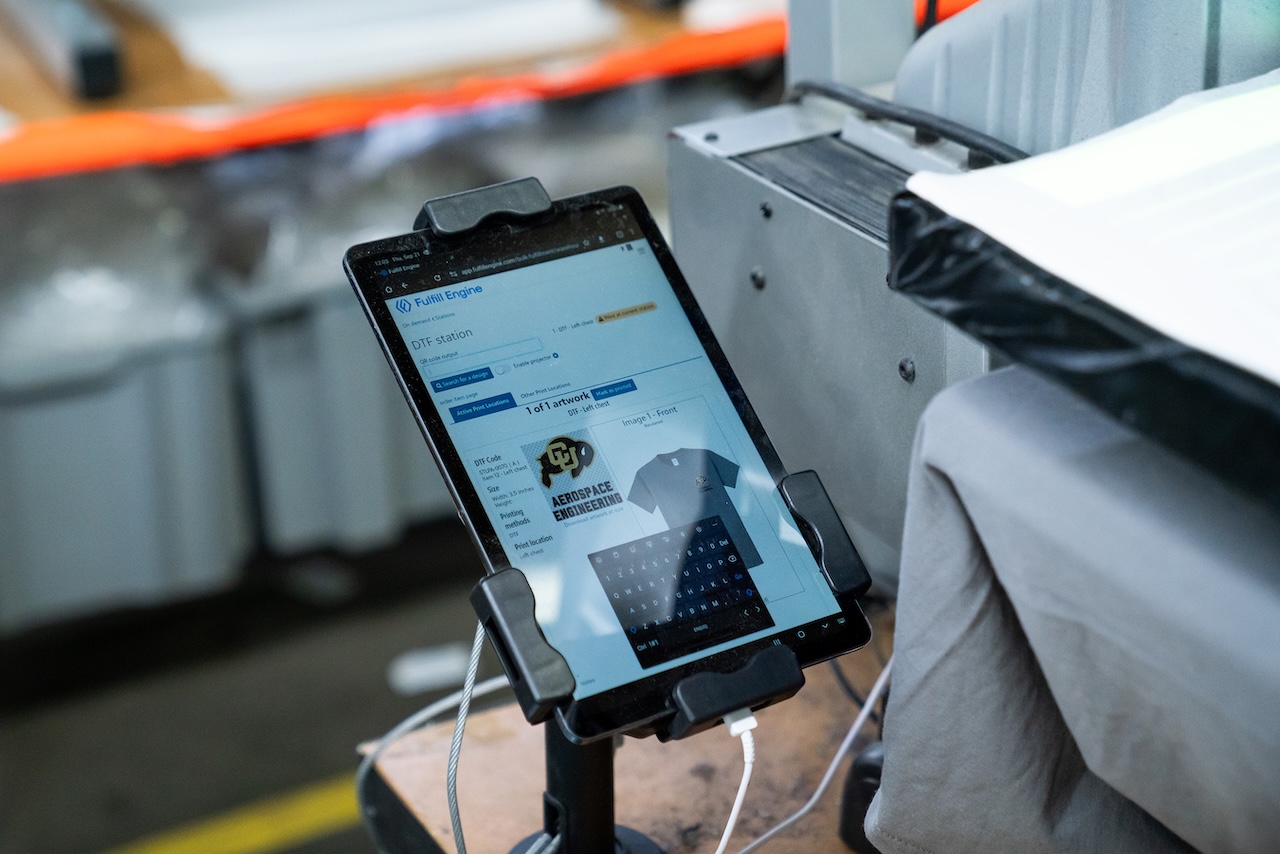
To get a handle on the production challenges it found itself facing, USColorworks decided to implement an entirely new kind of production software—Fulfill Engine, a comprehensive production automation platform STAHLS’ acquired in 2023 that tracks and coordinates each and every order passing through USColorworks’ shop via a scannable label with a unique QR code; an approach that has allowed USColorworks to eliminate the need for its operators to have to make the countless micro-decisions they had to make in the past, as Fulfill Engine tells the worker at each station exactly what needs to be done.
The result is a system that allows the shop to process thousands of small on-demand orders profitably at the same time it continues running those same bulk orders it’s been running since its inception. The system even includes an easy-to-learn operator interface that allows the company to reliably scale and flex a powerful part-time, seasonal workforce of moms and kids looking for a little extra income. Of course, there are any number of other e-commerce and production management software solutions out there worth considering as well. However, what makes Fulfill Engine unique is the way it seamlessly connects the production process from start to finish, from the moment an order comes in to the moment it goes out the door.
And this kind of automation isn’t just for operations the size of USColorworks. Custom decorator Sew N Pressed, for example, though a much smaller shop, found itself facing a similar set of challenges. Specifically, as its ecommerce business expanded, so did order complexity. Multiple sizes, mixed decoration methods, individual shipments: without a centralized system to keep track of what needed to be printed, pressed, packed and shipped, the situation quickly became overwhelming.
The turning point came when the husband-and-wife team at Sew N Pressed implemented the same system as USColorworks to automate order intake, artwork handling, production batching, blank sourcing and fulfillment. Instead of simply reacting to orders as they came in, the shop was now able to gain more time in its day by being able to see what was coming next. The resulting increase in visibility reduced error, shortened turnaround times and allowed the team to focus on the work at hand, as opposed to continually having to engage in firefighting.
In less than a year, Sew N Pressed scaled from a handful of online stores to dozens, without having to worry about the situation descending into chaos. That’s the quiet power of automation: growth feels controlled instead of frantic.
Better still, the end result wasn’t just fewer errors, it was a growing sense of confidence. Confidence to open more stores. Confidence to offer more customization. Confidence to compete and grow based on the quality of the company’s service as opposed to just output.
Protecting Throughput While Expanding Offerings
Another one of the more compelling transformations I’ve seen took place at T-Formation, a custom apparel located near Tallahassee, Florida. Like many contract shops, T-Formation built its reputation on large-quantity screen printing. Then came all the aforementioned changes in its customers’ behavior. Smaller orders, more colors, more customization: it all threatened to disrupt the efficiency of the homebuilt systems they’d created over the years.
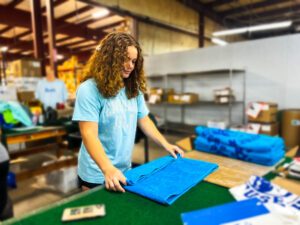
When a shop is well organized, workers can focus on producing, as opposed to having to try and figure out what they’re supposed to be doing. Photo courtesy of STAHLS’/USColorworks
Rather than continuing to force every job through the same old system, though, T-Formation chose to begin using Fulfill Engine in order to better guide production of its smaller jobs, regardless of quantity, complexity or decoration method. The result was not only improved workflow but the confidence to make a number of new equipment decisions. These included investing in in a state-of-the-art Kornit Apollo printing system for high-color, on-demand or bulk jobs.
The key insight here is the fact automation didn’t replace screen printing, it protected it. By using software to manage order flow and decision-making, T-Formation was able to expand into on-demand and personalization without sacrificing the bulk orders that had made its operations profitable in the first place. Jobs of any size can now move through the system without overwhelming staff or introducing errors. That’s the difference between reacting to change and designing for it.
Why Systems Matter More Than Ever These Days
Skilled labor is harder to find than ever in our industry. Training takes time. Turnover is expensive. When critical knowledge lives only in someone’s head, every absence becomes a risk. The good news is production automation software addresses this quietly but effectively. It standardizes decisions. It documents processes. It makes training faster and performance more consistent. New hires don’t need to memorize every rule. The system guides them.
Again, whether it’s better process control or an increasingly effective workforce, automation builds confidence. Owners know what’s in the shop, what’s late and what’s going to be coming down the pipeline days from now. Operators know what to expect. Customers get what they ordered, when it was promised to them. The result is not just being better able to handle print on demand, but every order that walks in through the door.
Dave Conner is a veteran decorated apparel industry educator, content creator, Impressions Expo educational conference presenter and Director of Product Marketing at STAHLS’—an industry-leading provider of custom heat transfers and heat-transfer equipment. Most recently, the company also launched its award-winning Fulfill Engine, what the company describes as, “The ultimate e-commerce and production management solution.” For more on STAHLS’/TXP and its complete line of products and services, go to stahls.com.