No one comes out of high school or college saying, “I want to start an embroidery and apparel decoration business.” For Sheri Blackiston, owner of Maryland-based Graphic Reflections, embroidery wasn’t so much a career choice as it was an answer to a problem. When her daughters got involved in sports, she found the cost of team apparel, especially personalized gear, was distressingly high. She, like many parents, found herself staring at the price tag of the team gear and thinking, “There has to be a better way. Maybe I can do this myself,” which in turn led to the purchase of a small single-needle embroidery machine as a possible solution.
Blackiston quickly discovered, “Embroidery looks like it should be simple… [but] it is so not.” Even so, the “little machine that could,” as she calls it, opened the door to a whole new world of possibilities. After that, a casual stop at a Joann Fabrics for quilting supplies led to another unexpected discovery, a Husqvarna embroidery machine. It was not long before she upgraded her embroidery setup.
From Hobby Projects to Customer Orders
Over time, quilting and embroidery projects for friends turned into requests from people who wanted names added to jackets, bags and everything else under the sun. “You can bring me anything you want, and I’ll decorate it, just let me tell you the risks,” Blackiston says. She adds she is one of the only businesses in the area, if not the only one, that will work on customer-provided goods. As the orders grew, so did the need for better equipment.
Then came an unexpected turning point, when she walked into a sewing shop intending to buy a long-arm quilting machine and somehow ended up walking out with a 10-needle embroidery machine. “I had no idea how that happened,” she admits, “but that was where it really began. It was just…fun.”

Upgrading Equipment Helped the Business Grow
As her business grew, Blackiston looked into other commercial embroidery equipment as well. While a home multi-needle machine was a great starting point, it had its limits. She loved the concept of her first commercial machine; however, the equipment didn’t meet the practical needs of her growing customer base. Among other things, her first machine couldn’t embroider hats, one of the shop’s most requested items.
Eventually she traded up to a Barudan single-head, noting “I learned very quickly that Barudan was going to be my best friend.” Not only that, but once she had the right machine, “everything started moving like wildfire,” she says. The business expanded rapidly, they began embroidering hats, T-shirts, team apparel and a range of other custom gifts with precision.
Next thing she knew, many of her customers were asking for more than just embroidery, which in turn resulted in her not only learning how to work with heat transfer vinyl, but becoming an authorized STAHLS’ CAD-CUT dealer as well, selling vinyl supplies and instructions to local crafters. To meet the ever-expanding and evolving needs of her growing customer base, she also eventually found herself taking on other apparel decoration capabilities, like sublimation, direct-to-garment (DTG) and direct-to-film (DTF) printing.
Adaptability Opened the Door to New Opportunities
When the pandemic arrived, she had the skills, the equipment and the willingness to pivot quickly. Her daughter worked in food service at the local hospital, where the staff desperately needed masks. Thanks to years of fabric hoarding from her quilting days, Blackiston had a mountain of fabrics available. She began creating in-the-hoop masks and delivering them to the hospital. She donated more than 2,500 masks by the end of the pandemic.
These efforts in turn led directly to an embroidery contract with that same hospital for scrubs and uniforms, a testament to her quality service and willingness to adapt. The hospital system remains a major client to this day. Better still, she now has contracts with a number of other facilities for their scrubs as well.
“If you see a need and you help, people remember. That can lead to business opportunities you didn’t expect,” she says.

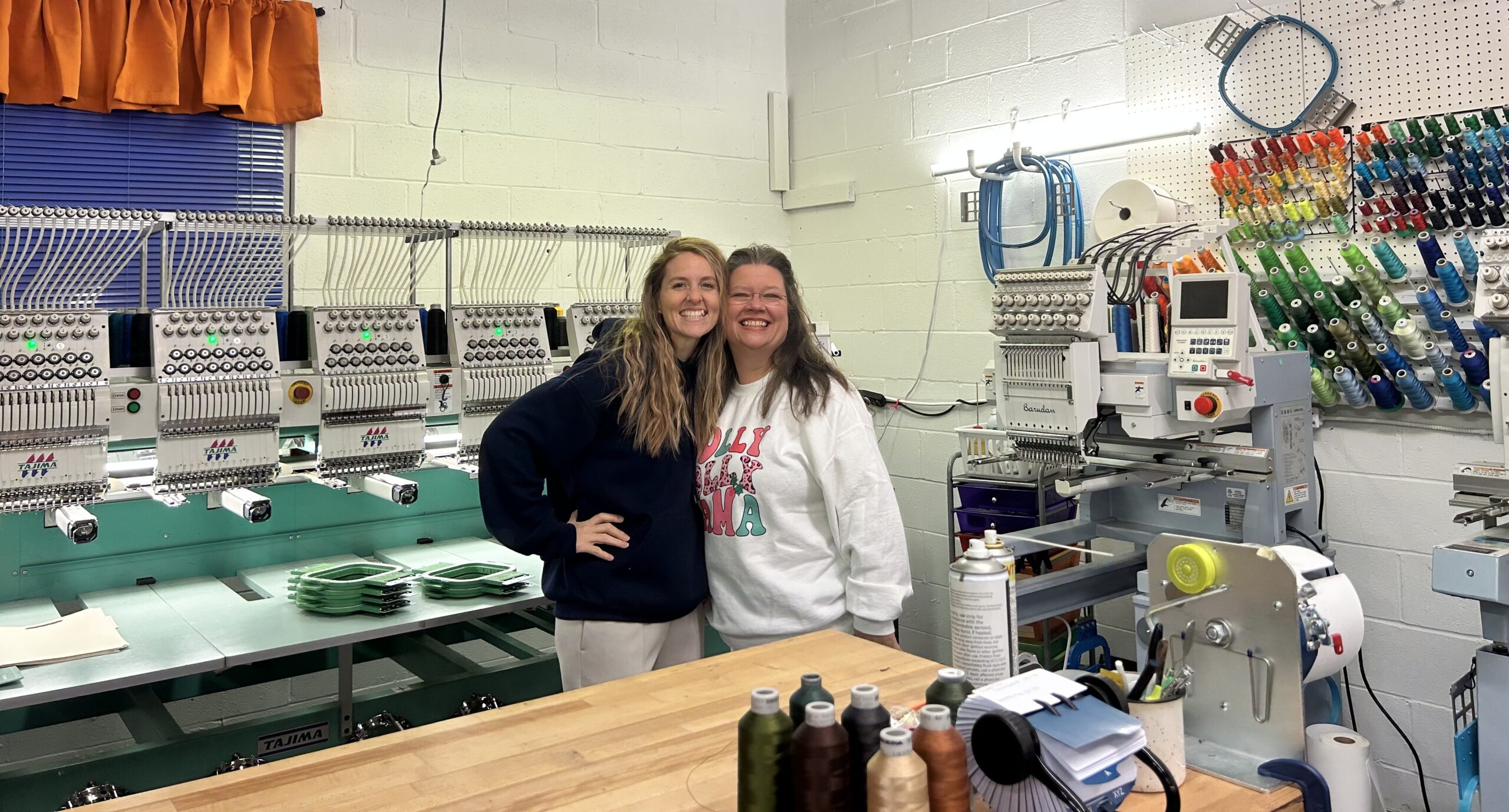
Though the company’s initial endeavors were in the area of embroidery, it has since branched out to include a wide range of decorating methods. Photo courtesy of Graphic Reflections
A Home-Based Embroidery Business With Room to Expand
Through it all, the business remained home-based. Keeping overhead low allowed for competitive pricing and flexibility. Joining the National Network of Embroidery Professionals (NNEP) in 2018 provided templates that made pricing straightforward and transparent, eliminating guesswork. “People respect our prices because they are clear and fair,” she notes.
As time went by, Blackiston and her husband bought a 10-acre property with a two-and-a-half-bay garage and some other outbuildings. “The plan was for him to use the garage. That plan lasted about five minutes,” she chuckles, as the garage quickly became her production center. Today, her equipment list includes a six-head Tajima, two Barudans and a wide range of print capabilities for handling both retail and contract work, including with several local screen-printing shops.
There was also a small shed that looked like a little woodland cottage on the property when she and her husband bought it. Instead of letting it sit unused, though, she converted it into a storefront gift shop. Customers now come to the cottage to drop off orders, pick up goods, shop seasonal collections, browse decorated scrubs, and explore the vinyl, transfers, ornaments and ready-to-press graphics she has on display.
The shop is open Fridays and Saturdays for browsing, with some Sunday hours during the holidays. Customer meetings, pickups and drop-offs take place Monday through Thursday evenings from 6 to 9 p.m. “It’s a long day, but it’s worth it,” she says. “Our customers are worth it.”
While many decorators compete on price, her approach is a bit different. Yes, her pricing is often lower than competitors’, but not because she involved in any kind race to the bottom, as it were. It’s because her overhead is lower. For example, she’s able to offer the convenience of retail hours without all the expenses associated with running a completely separate retail location. She also still uses the NNEP pricing templates started out with early on, noting it helps customers understand the value of what they’re paying for. “Our first question is always: How can I serve you?” she says.
In terms of marketing, she notes customer service remains the backbone of everything she does as well. “Word-of-mouth has outperformed every ad I’ve ever paid for,” she says. She’s also joined not one but four local chambers of commerce where she makes a point of showing up consistently as a kind of community outreach. And while she jokes that she’s not naturally outgoing, she’s learned to be comfortable walking into a room and asking people about their businesses, their needs and, most importantly, how she can help.
Advice for New Apparel Decorators
Her advice to new apparel decorators is pure gold: start small, learn your equipment and don’t be afraid to ask for help; master the basics of hooping manually before relying on hooping aids; understand each machine’s quirks; and build a consistent pricing system through structured templates. She also encourages new business owners to seek out a mentor, industry training and stressed how professional networks like NNEP can provide insights that save years of trial and error.
Along these same lines, Blackiston also emphasizes the importance of good negotiation skills. “You are negotiating with your staff and with your customers, everyone!” she says. “You have to negotiate with your staff to keep morale where it needs to be…then there is negotiating with customers, because they come in with an idea of what they want, and most of the time, it is not something that needle and thread will do well. So, we need to negotiate with these customers so we can get their idea to where they will love it without it looking ridiculous or be unachievable with needle and thread.
Building a Team and Training for Consistency
These days, her staff consists of two women, who she says “are like family.” One grew up with her daughter and has been with the shop for six years. The other joined more recently and immediately fit in. Both ladies share a desire for a flexible work schedule that supports their families and gives them a creative outlet.
Training begins with a foundational embroidery education. Blackiston swears by the classes she’s taken from Joyce Jagger, The Embroidery Coach (theembroiderycoach.com), which she calls one of the best investments she ever made. Blackiston also instructs her staff on the hands-on skills needed to master tension, thread machines properly and build the confidence necessary to doing the job right.
“If you don’t have patience for embroidery, you work on the print side,” she says. “You have to learn what that pull of the thread should feel like. There’s no shortcut. Experience is the only teacher for that.” Her staff responded well to the challenge, and the shop now runs with consistency that customers can trust.
Growth, Flexibility and Long-Term Vision
Looking ahead, in the coming year, she expects to retire from her other full-time job and transition fully into the business, after which, in five years or so, she hopes to step back even more, at least physically. Her dream is to be able to run the business remotely while spending more time outdoors—preferably sitting on a sandy beach with a breeze in her hair.
Her two staff members share her vision, and she sees them eventually running the shop day-to-day. The goal isn’t to walk away, but to build a business that can thrive without her being on the production floor daily.
What won’t change is the shop’s foundational values: service, quality and community. “It’s never been about what or how much we can make,” Blackiston says. “It’s always been about how we can best serve the people who walk through our door.”
As the founder of the National Network of Embroidery Professionals (NNEP), Jennifer Cox has worked with thousands of embroidery- and decorated-apparel business owners to help them build successful businesses for over the past 25 years. NNEP supports members with services, savings and programs designed to help its members find customers, keep customers and make money. To find out more, or share any of the challenges your own company me currently be experiencing, go to NNEP.com.