The idea of hiring a person with a disability may be an intimidating one, but it shouldn’t be
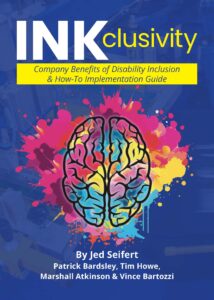
The following is an excerpt from the newly published book INKclusivity: Company Benefits of Disability Inclusion & How-to Implementation Guide, written to “inspire and guide [business leaders] in building a more inclusive workplace—one that embraces the talents of individuals with developmental disabilities.” The book, which can be downloaded for free at inkclusivity.com, highlights the advantages of employing individuals with disadvantages and explains how companies can do so successfully.
 Jed Seifert is the co-founder of Stakes Manufacturing (stakesmfg.com), a cutting-edge print-on-demand production and fulfillment company in Eastlake, Ohio shipping millions of units of decorated apparel, headwear and bags annually from its 110,000-square-foot facility. Of its 275 employees, 10 percent have intellectual and development disabilities. In 2022, Stakes MFG. was named National Employer of the Year by APSE (apse.org—the Association of People Supporting Employment First) for his and fellow co-founder and co-author, Vince Bartozzi’s, efforts to hire people with disabilities. In 2024, Jed was also recognized as ASI’s Counselor Bess Cohn Humanitarian of the Year.
Co-authors Patrick Bardsley, co-founder and CEO, and Tim Howe, COO, operate Spectrum Designs (spectrumdesigns.org), a New York-based non-profit custom apparel and promotional products business approaching $10 million in annual sales. Its name reflects its social mission to create meaningful, inclusive employment and vocational training for neurodiverse individuals who work in all areas of the business. It currently operates as a competitive, integrated workplace with 56 of its 82 employees being neurodiverse.
Marshall Atkinson is an industry veteran, the principal of Atkinson Consulting (marshallatkinson.com) and a business coach with more than 30 years of experience in the printing industry. A family connection to autism inspired his desire to support and promote the inclusion of people with disabilities in the printing industry.

Taking the First Step: Gaining a Better Understanding
You understand the needs of your business center around a strong, talented and stable workforce. You recognize the benefits of a diverse team will make your business better. So, what’s stopping you from hiring people with disabilities?
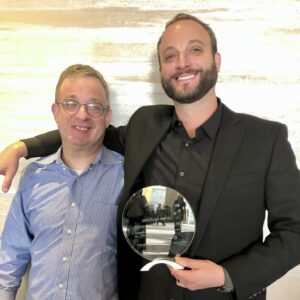
Brothers Darren (at left) and Jed Seifert at the 2022 APSE National Conference, where Stakes MFG received the Employer of the Year Award for its efforts to provide employment opportunities for individuals with disabilities. Photo courtesy of Stakes MFG
Often, we are faced with our own biases, stigmas and stereotyping. These conscious, and sometimes unconscious, biases impact us all, and are not just around race, gender, and sexual orientation. Ableism is defined by the American Psychological Association as the “discrimination against people with disabilities, prejudice, and negative stereotypes that often portray them as less intelligent, non-productive, or dependent,” often with a patronizing desire to “cure” their disability and make them “normal.” This “ism” is one of the most common and most divisive, as it treats people with disabilities as less than, and worse, as having something that needs to be fixed or treated.
Through no fault of your own, you may not have had the opportunity to work with or get close to talented individuals with disabilities. This is common, but it’s often not the sole reason organizations and decision-makers fail to create broader inclusion. Our attitudes, stereotypes, and beliefs can create fear and stigma, which often act as barriers that need to be overcome. You might have concerns about safety, potential increases in workers’ compensation insurance, a drop in productivity due to longer training times, or increased sick time. However, these are often just excuses, as several studies over the years have debunked these common myths. Recognizing and understanding the underlying fears is key to addressing them and overcoming the stigma. As a leader, you need to take the first step in creating change.
Fears Aren’t Facts: Excellence Remains the Goal
Thoughts and emotions based on the fear of hiring someone with a disability must be recognized and challenged because they are a result of a lack of exposure and ignorance.
As a business owner, you may fear the unknown cost of hiring someone with disabilities. Will it be worth it, and will it negatively affect profitability? What if there is negative publicity or even a lawsuit? How do I talk to or act with an employee with disabilities? Will I be judged by them, their family, or community? Will someone think my company is trying to capitalize on employing people with disabilities unfairly?
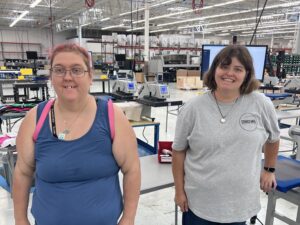
Julie (left) and Danielle led the way as the first two employees with disabilities to work in Stakes’ heat press department. Photo courtesy of Stakes MFG
The biggest concern is often whether your company is ready to hire someone with disabilities and can afford to provide the necessary resources to support them. However, there is a tremendous disability employment service provider community that assists companies in implementing these programs for free. Disability employment service programs can help with new employee job placement, onboarding, training, on-site job coaching, and management support at no cost to the employer. Sometimes there is even financial support to hire and train a person with disabilities.
“The question isn’t, ‘Are you prepared to hire someone with a disability?’ The question should be ‘Are you prepared to fire someone with a disability?’ Because they’re only looking for an opportunity they didn’t otherwise have,” says Spectrum Design’s COO, Tim Howe. “You’re still trying to hire the best candidate for the job. Inclusion is about widening the gate so people who can’t immediately knock on the door can enter the hiring process.”
You always want to hire the most suitable candidate, but there may come a time when that employee needs to be disciplined, placed on a performance improvement plan, or terminated. The thought of this often scares employers and managers. However, the disability community isn’t expecting companies to hire them simply to avoid accountability. If you don’t address performance issues or violations of company policies, even with the support of a job coach, it can jeopardize the entire disability inclusion program. There are many other qualified, unemployed individuals with disabilities who are eager for a chance to take their place.
“We want to hire career print and graphic design professionals who happen to have a diagnosis or a disability,” Tim says. “Our long-term goal is to create seasoned, productive professionals. So, what if he flaps his hands or talks to himself quietly while working? Does that interfere with his customer emails or his press operation? This is about job performance and widening the candidate pool.”
Embrace Differences: Workers with Disabilities Have Much to Offer
No one in Tim’s family is diagnosed as developmentally disabled. When he came to Spectrum Designs, it was his first time encountering people with disabilities. “I was sitting in a room working on a spreadsheet and overheard some self-talk or scripting,” he says. “They were talking to themselves and repeating the same words of frustration. To me, it sounded not just crazy, but a bit scary. Hearing someone talk to themselves reminded me of something from a movie.”
After a couple weeks, though, Tim discovered the employee was the most fascinating, honest human being he had ever met. “I realized what had terrified me was an amazing new way of looking at the world,” Tim says. “He says exactly what he thinks.” Something as simple as not cleaning up after a task would trigger a reaction in the employee. Any other person might not have noticed or would have let it slide, but he would immediately jump in and point it out.
“At Spectrum, there are a hundred ways of seeing things with a hundred individuals, but everyone has something special,” says Tim. “Some staff can spot a small difference in a print that others wouldn’t notice. Some hear the difference between a machine running correctly and something wrong with a belt bearing. They can find a problem others might not see and have complete clarity about it. This means we may hear the truth about something whether we are prepared or not.”
Assumptions vs. Abilities: Disabilities—and Abilities—Vary Widely
Disabilities exist on a vast and diverse spectrum, each affecting individuals in unique ways. While some disabilities may impact physical mobility, others affect cognitive or sensory functions. However, it’s crucial to understand that within this wide spectrum lies a wide range of abilities. People with disabilities possess a range of skills, talents, and strengths that may go unrecognized if we focus on their limitations rather than their potential. Too often, societal biases and preconceived notions lead to underestimating what these individuals can contribute, especially in the workplace.
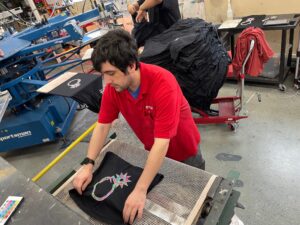
Veteran decorated Spencer Pusey fills multiple roles as part of the production team at Spectrum Designs. Photo courtesy of Spectrum Designs
We cannot afford to make assumptions about what jobs people with disabilities are suited for. The truth is many people with disabilities thrive in professional roles despite low expectations. For instance, someone with limited mobility may excel in data analysis, programming, or graphic design, while a person with a learning disability might have an exceptional talent for problem solving or creative thinking.
Stakes MFG has an employee with cerebral palsy who uses a wheelchair initially apply for a job folding T-shirts. Stakes co-founder Jed Seifert said she didn’t have the best dexterity to use a flip and fold, but they still gave her a chance. After a couple of weeks on the job, he joined her at lunch to learn more about her. It turns out she has a degree in cybersecurity from a major university. Jed asked why she was folding T-shirts. She explained that no one would give her a chance to do anything else. All they saw was her wheelchair and disability.
“I spoke with our CTO to determine how we could transition her from folding T-shirts to working at a computer to use her true strengths,” says Jed. “Soon after, she was building inventory and custom client reports, and has been working on the computer for Stakes ever since.”
The idea that disabilities confine individuals to a narrow set of jobs ignores the diversity of human capabilities, and that success comes from adapting tasks to fit people’s abilities rather than the other way around.
The first question many people ask is: “What level of disability are we talking about?” The days of seeing a linear spectrum of disabilities are now replaced with a nuanced understanding of specific skills. Sure, there are levels within a disability. Some deaf individuals may have partial hearing, while others may have none. You have to ask, “How does that change how the work is performed?” If they are emailing proposals or checking in garments, not at all. What about an intellectual disability? This is even more nuanced, and no two human beings are the same.
“One person with autism might write in perfect English, which is fantastic,” says Tim. “Another person with autism might not be able to read. You need to determine how to teach these individuals in a slightly different way, and assess your workplace and staff to prepare for all these possibilities.”
By broadening our understanding of what’s possible, we unlock a world of opportunities for employees and employers.
“I know founders and C-level executives with disabilities,” says Jed. “I met a person with no hands who beat me in video games and can throw a perfect spiral with a football. I met a nonverbal child who became a famous painter and sold her pieces for $10,000 or more. I met a young gentleman with Down Syndrome who launched a clothing brand during the pandemic that did seven figures in its first full year and another who founded a successful seven-figure printed sock business. Just because someone has disabilities doesn’t mean they can only do low-skilled tasks. We must stop putting limitations on people and start focusing on the individual’s abilities and possibilities.”
Tackling the Myths of Hiring Workers with Disabilities
If you’re saying, “There’s no way I’m going to get the same results if I hire a person with disabilities,” you may not be seeing the full picture. If all you see is the disability, you are not open to all the other qualities and benefits the person brings. Your preconceived notions of people with disabilities are too strong and inaccurate. You’re not conducting a full strengths, weaknesses, opportunities and threats (SWOT) analysis of the person. People with disabilities have strengths and benefits that are overshadowed by their labels.
“Many of our top-performing employees–measured by speed, accuracy, and attendance–have disabilities and they are held to the same performance standards as everyone else,” says Jed. “Some of those folks may have started as lower performers or took longer to learn the job, but they became our higher-performing employees through repetition, training, and effort.”
Once we are able to address the elephant in the room (the fears, judgement, and assumptions/biases) we can start to tackle the most common barriers put up by employers considering hiring someone with a disability. Many in the disability employment industry call these the myths, and, like a lot of myths, they have been around for a long time and persist to this day.
Myth: Employees with disabilities are unproductive at meaningful work.
Fact: In 1990, a research study by DuPont surveyed more than 800 employees with disabilities and discovered that around 90 percent rated average or better in their job. These results were comparable to DuPont’s findings from studies in 1981 and 1973. A Virginia Commonwealth University study found employees with disabilities “are as capable and productive” as employees without disabilities, including areas of timeliness, punctuality, task consistency and work speed.
Myth: Employees with disabilities use more sick leave.
Fact: Employees with disabilities have been shown to have the same absentee and sick rates as non-disabled employees. Industry reports consistently rate employees with disabilities as average or above average in performance, quality, and quantity of work. One study noted 86 percent of employees with disabilities have average or above average attendance. Another study noted 33 percent of employees say that a colleague with a disability works as hard as non-disabled colleagues, while 46 percent say that employees with disabilities actually work harder.
Myth: Under the ADA, employers must give people with disabilities special privileges, known as accommodations.
Fact: Yes, reasonable accommodations are mandated when an employee discloses a disability. However, the pertinent term is “reasonable.” A reasonable accommodation is a modification to a job, environment, or way work is performed that allows an individual with a disability to apply for the job and perform the essential functions of the job. Note, the ADA does not give hiring preference to persons with disabilities.
Myth: Supervising employees with disabilities will be difficult.
Fact: A Harris poll found that 82 percent of managers said employees with disabilities were no harder to supervise than non-disabled employees. Employees with disabilities should be held to the same job standards as any other employee.
Myth: People with disabilities require expensive accommodations.
Fact: A study by the Department of Labor’s Job Accommodation Network (JAN) noted 58 percent of accommodations cost little to nothing and the rest usually cost $500 or less. The vast majority of employers (73 percent) report their employees with disabilities did not require accommodations.
Myth: Hiring People with disabilities will increase workers compensation insurance.
Fact: Insurance rates are based solely on the relative hazards of the operation and the organization’s accident experience, not on whether the organization hires people with disabilities. As noted by the Discover Ability Network of Canada, employees with disabilities have a 40 percent lower safety incident rate, and 78 percent lower overall costs associated with accidents.
In addition to downloading INKclusivity in its entirety (free or charge) at inkclusivity.com, contact APSE, at apse.org, to learn more about the many free programs and services available to companies interested in hiring individuals with disabilities.