Direct-to-film (DTF) printing has already reshaped apparel decoration, but for many apparel decorators and shops working in DTF and heat-applied transfers, the true profitability breakthrough isn’t the printer itself but the formidable gang sheet.
What started as a simple idea, placing multiple designs on a single sheet, has evolved into a strategic production method that’s redefining how shops think about cost control, workflow efficiency and scalability. When combined with modern online gang sheet builders, the approach is helping decorators run leaner operations while taking on more diverse and profitable work.
In today’s environment, where short runs, on-demand fulfillment and customization are the norm, gang sheets are no longer just a helpful option. For many decorators, they’re becoming foundational to staying competitive.
How Gang Sheets Reduce DTF Printing Costs by Up to 60%
At the most basic level, gang sheets allow decorators to consolidate multiple designs often across different customers, garment types or order sizes onto a single transfer sheet. But the real impact comes from how that consolidation affects pricing.

Instead of paying setup and production costs for each individual transfer, decorators spread those costs across an entire sheet. The result is a dramatic reduction in per-piece pricing, often in the range of 40 to 60 percent compared to ordering designs individually.
That shift fundamentally changes how decorators approach quoting and profitability. Jobs that once felt marginal or even unworkable suddenly become viable.
Providers like my company, Ninja Transfers, have built their ordering systems around this model, giving decorators the ability to mix multiple designs on a single sheet without minimums. That flexibility removes one of the biggest friction points in custom apparel: the need to commit to volume before knowing if a design will sell.
Why Workflow Efficiency Matters More Than Ever in Apparel Decoration
While cost savings often grab the headlines, many decorators find that the operational benefits of gang sheets are just as valuable.
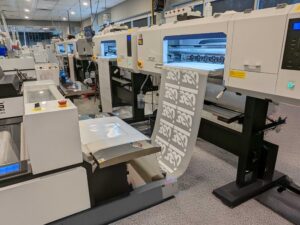
Modern DTF production lines print high-volume gang sheets efficiently, enabling decorators to streamline workflows and scale output without increasing labor. Photo courtesy of Ninja Transfers
By thoughtfully arranging designs, shops can maximize nearly every square inch of transfer film. It’s not uncommon for experienced decorators to achieve utilization rates above 85 percent, meaning very little purchased material goes to waste.
That level of efficiency has a ripple effect. Less waste means fewer discarded materials, fewer unnecessary reorders and a more predictable production cycle overall.
Just as important, gang sheets simplify the physical workflow. Instead of managing stacks of individual transfers, production teams work from a single, organized sheet. Designs can be grouped intentionally by customer, order or deadline, which can create a clearer path from press to fulfillment.
In many shops, this alone reduces errors and speeds up turnaround times.
How Gang Sheets Power Print-on-Demand and E-Commerce Growth
The rise of e-commerce and print-on-demand (POD) has forced decorators to rethink how they handle small orders. Traditional methods often penalize short runs, making them difficult to produce profitably.
Gang sheets flip that model.
Because multiple designs can share the same sheet, decorators can fulfill one-off orders, test new artwork or produce small batches without incurring traditional setup penalties. A single sheet might include a mix of custom customer orders, retail designs and sample pieces all produced efficiently in one run.
This flexibility is especially valuable for decorators running online stores or experimenting with new markets. Instead of committing to large inventory buys, they can validate ideas in real time.
In practical terms, it means saying yes to more opportunities without increasing risk.
The Role of Online Gang Sheet Builders in Modern Production
If gang sheets are the engine, online creation tools are what make them scalable.
In the past, decorators often relied on their transfer provider to arrange layouts, which created a disconnect between what was ordered and how it was produced. Today’s browser-based gang sheet builders eliminate that gap.
Online platforms like the integrated builder we have available at Ninja Transfers, allow decorators to upload artwork, arrange layouts visually and see exactly how their sheet will be produced before placing an order. That transparency removes guesswork and dramatically reduces back-and-forth communication.
More importantly, it shifts control back to the decorator. Decisions about spacing, sizing and layout efficiency are made in real time, with immediate visibility into how those choices affect cost.
For many shops, this has also reduced the need for dedicated prepress labor, freeing up time and resources for higher-value work.
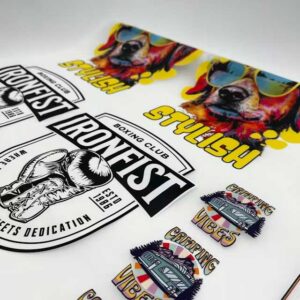
A mixed-design gang sheet showcases how decorators combine multiple customer orders on a single sheet, improving efficiency and enabling profitable short-run production. Photo courtesy of Ninja Transfers
Smarter Tools Reduce Errors in DTF Production
Another major advantage of modern gang sheet software is its ability to prevent errors before they happen.
These tools act as a built-in quality control system, automatically flagging issues like low-resolution artwork, improper sizing or designs placed too close together. In many cases, they catch those same problems that would otherwise lead to unusable transfers or costly reprints.
For decorators without in-house design teams, this is a significant benefit. The software effectively embeds best practices into the workflow, guiding users toward production-ready layouts without requiring deep technical knowledge. It also reduces stress on the back end. Instead of discovering issues after transfers arrive, shops can address them upfront, keeping production on track.
How Gang Sheets Lower Barriers for New Decorators
One of the most important shifts driven by these tools is accessibility.
Not long ago, creating efficient gang sheets required design software, experience and a fair amount of trial and error. Today, intuitive drag-and-drop interfaces and guided workflows make it possible for almost anyone in a shop to build a professional layout.
That democratization changes how businesses operate. Owners can prepare jobs after hours, production staff can handle layout tasks during slower periods, and small teams can function without relying on outside design resources.
Companies like Ninja Transfers have reinforced this accessibility with educational resources and tutorials, helping decorators get up to speed quickly and avoid common pitfalls.
For newer decorators, this removes one of the biggest barriers to entry. For established shops, it creates new efficiencies that scale with growth.
Maximizing Profitability with Strategic Gang Sheet Planning
For decorators focused on margins, gang sheet strategy often becomes a key differentiator.
A well-optimized sheet can reduce transfer costs by 30 to 50 percent, and those savings go directly to the bottom line. But the impact goes beyond material costs.
Better organization reduces the likelihood of applying the wrong transfer to the wrong garment. It minimizes reorders, cuts down on production delays and allows shops to process more orders with the same labor.
For e-commerce-driven decorators, this efficiency can determine whether small custom orders are profitable or not. When multiple customer orders are combined into a single gang sheet, previously marginal jobs become worthwhile.
In many cases, shops see margin improvements without adding new customers simply by improving how they structure their production.
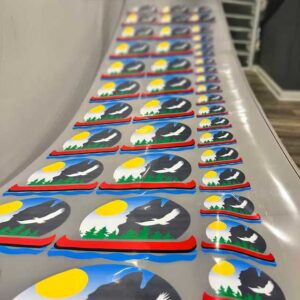
Finished gang sheet transfers highlight the versatility of DTF printing, delivering full-color designs that can be cut, applied and fulfilled quickly for on-demand orders. Photo courtesy of Ninja Transfers
Common Gang Sheet Mistakes Decorators Still Make
Despite the advantages, gang sheets aren’t foolproof. Some of the most common issues still come down to planning.
Designs are sometimes packed too tightly, making them difficult to cut or apply. In other cases, decorators mix graphics that require different pressing conditions, creating confusion during production. Perhaps most commonly, shops will leave significant portions of the sheet unused, essentially paying for blank film. Again, modern software helps mitigate these mistakes. However, it doesn’t replace thoughtful decision-making. The most successful decorators treat gang sheet layout as a strategic step, not an afterthought.
A few extra minutes spent optimizing a layout can translate into meaningful cost savings and smoother production.
What’s Next: AI and Automation in Gang Sheet Layouts
As DTF continues to grow, gang sheet tools are evolving into something much more sophisticated.
The next wave of innovation is likely to include AI-driven layout suggestions that analyze designs and recommend optimal arrangements based on past orders. Integration with e-commerce platforms will allow decorators to automatically generate gang sheets from incoming orders, reducing manual work even further.
We’re also beginning to see early signs of pricing intelligence, tools that show how different layouts affect profitability, and inventory integrations that help decorators plan sheets based on real consumption patterns.
Companies operating at scale, such as Ninja Transfers, are particularly well positioned to drive these advancements. By leveraging real production data, they can build tools that reflect how shops actually operate, not just how software is designed in theory.
Why Gang Sheets Are the Future of Apparel Decoration
For apparel decorators, gang sheets represent more than a production tactic; they’re a smarter way to run a business.
They bring together cost efficiency, workflow clarity and digital tools in a way that aligns perfectly with the realities of modern decoration: short runs, fast turnaround and constant customization.
As online tools continue to improve, the gap between small shops and large operations will continue to shrink. Decorators who embrace gang sheet optimization today aren’t just improving efficiency, they’re building a more scalable, resilient business for the future.
And in an industry where every margin matters, that’s an advantage worth mastering.
At Ninja Transfers, Aidan Nichols is an industry veteran, helping drive creative, marketing, and product innovation for one of the fastest-growing DTF companies in the custom apparel space. After spending more than a decade working directly in production, Nichols now sits on the other side of the business, translating real shop-floor experience into better products, tools, and storytelling for decorators, creators, and brands. His work bridges operations and creativity, ensuring Ninja’s technology empowers businesses to make high-quality, full-color apparel with speed and confidence.