
Fast fashion has long been associated with massive production runs, overseas supply chains and mountains of leftover inventory. But inside today’s decorated-apparel shops, a very different version of “fast fashion” is taking shape: one that’s quicker, smarter and (thankfully) far less wasteful. At the center of this shift is print-on-demand (POD) apparel production, allowing decorators to produce garments only after an order is placed.
For small and mid-sized decorators, POD is more than a buzzword. It’s a practical, revenue-driving way to say “yes” to more customers without overcommitting resources. Thanks to automation, e-commerce integrations and flexible decoration technologies like direct-to-film (DTF), shops can now produce apparel only when it’s ordered… even if that order is just one shirt.
The result? A new kind of fast fashion, which is local, trend-driven and refreshingly sustainable.
So how do you bring print-on-demand into your shop without turning your workflow upside down?

Let’s break it down.
Step 1: Start Small with Print-on-Demand Production
Before you start pricing out equipment or reworking your entire production floor, take a breath.
You don’t need to go all-in on print-on-demand from day one. In fact, the most successful decorators often ease into it by identifying where the model delivers the greatest value. POD is particularly well suited for spirit wear programs that require frequent reorders, corporate apparel that changes with the seasons, fundraising campaigns with unpredictable demand, creator merchandise drops and those last-minute “Hey, can I just get one more?” orders that can be difficult to fulfill through traditional production methods.
Shops like Shirt Co., St. Charles, M.O., didn’t reinvent everything overnight. They simply shifted select web stores from batch production to always-on fulfillment. Suddenly, orders didn’t have to wait. Revenue didn’t have to pause. And customers didn’t have to hear, “Sorry, that store closed last week.”
Small change. Big impact.

Print-on-demand lets apparel decorators keep webstores open year-round, fulfilling orders as they arrive instead of waiting for traditional order deadlines or large production batches. Photo by AntonioDiaz – stock.adobe.com
Step 2: Build Always-On E-commerce Web Stores
If print-on-demand is the engine, e-commerce is the fuel.
Instead of opening and closing stores like it’s a seasonal pop-up, POD shops keep stores running 24/7. That means orders can roll in at 2 p.m. or 2 a.m., and your production line doesn’t skip a beat.
Sew N Pressed Customs, Holtsville, N.Y., leaned into this model early, scaling from just a couple of stores to dozens in less than a year all while keeping turnaround fast and designs fresh.
The beauty of always-on stores:
- No more deadline pressure for customers
- No more order collection bottlenecks for you
- A steady stream of work instead of feast-or-famine cycles
Think of it as turning your shop into a retail brand without needing a storefront.
Step 3: Choose the Right Decoration Method for Print-on-Demand
Not all decoration methods embrace print-on-demand. Some simply tolerate it, while others truly thrive in the environment, and DTF falls firmly into the latter category. Its flexibility makes it an ideal choice for POD because it eliminates color limitations and screen setup while working across a wide variety of garment types. The process is especially well suited for one-off orders and short production runs, giving decorators the freedom to produce vibrant, customized designs quickly.
For Sew N Pressed Customs, DTF became a go-to because it delivers full-color, retail-quality prints without complicating production or inflating costs.
Pair it with embroidery, UV printing or heat-applied graphics, and suddenly your shop can offer a mix of products that feel like they came straight off a retail shelf.
Translation: more “wow” for your customers, without more headaches for your team.
Step 4: Automate Your Print-on-Demand Workflow
Here’s the truth: print-on-demand without automation is chaos.
Handling hundreds of one-piece orders manually? That’s a fast track to mistakes, delays and a very stressed-out production team.
Successful POD shops rely on automation to keep everything moving smoothly. Think of it as your behind-the-scenes production manager that never takes a day off.
For larger operations like USColorworks, Monroe, N.C., automation eliminates the need for constant decision-making on the production floor by allowing orders to move seamlessly through the workflow with built-in instructions and consistent execution at every stage. Orders flow automatically from web stores, blanks are purchased without manual input, items are tracked using barcodes or QR codes, production steps follow predefined processes that eliminate guesswork, and shipping is streamlined and consolidated.
Less clicking. Less thinking. More producing.
Step 5: Replace Batch Production with Continuous Workflow
If your shop is used to batch production, print-on-demand requires a bit of a mental reset.
Instead of waiting for 100 orders to stack up, POD is all about continuous movement. Orders come in, get processed and head out the door, often within a day or two.
Topshelf Printers, Greeley, C.O., learned this the hard way with a patchwork system that couldn’t keep up. Once they streamlined their workflow, they were able to scale significantly while reducing errors and shipping complexity.
A few ways to make the shift:
- Organize production by decoration type
- Standardize processes across stations
- Reduce the number of touch-points per order
- Keep things moving instead of waiting for “the perfect batch”
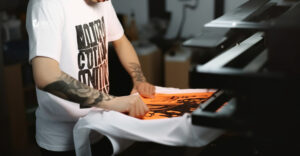
Direct-to-film (DTF) printing gives print-on-demand shops the flexibility to produce vibrant, one-off apparel orders quickly, making it an ideal decoration method for today’s e-commerce-driven customers. Photo by Kingboy – stock.adobe.com
It’s less like a sprint and more like a conveyor belt that never stops.
Step 6: Add Print-on-Demand Without Replacing Traditional Production
Good news: You don’t have to abandon screen printing.
Great shops are running hybrid models using bulk production where it makes sense and POD where it shines.
For example:
- Bulk for large, repeatable orders
- POD for reorders, personalization and e-commerce
USColorworks proves this model works at scale, producing tens of thousands of garments daily while still capturing high-margin POD orders on the side.
Think of POD as your flexibility layer, the thing that lets you say “yes” more often.
Step 7: Use Sustainable Print-on-Demand as a Competitive Advantage
Here’s a bonus: print-on-demand isn’t just efficient, it’s environmentally smarter.
Because items are only produced after they’re sold, there’s no excess inventory collecting dust (or heading to the landfill), which means less waste, smarter purchasing and lower risk when testing new designs.
And in today’s market, that’s something customers care about. So, don’t hide it. Highlight POD. It isn’t just fast; it’s responsible.
The Takeaway: Work Smarter, Stay Faster
Whether you’re adding print-on-demand to an existing apparel decoration business or launching a new e-commerce program, success starts by automating workflows, choosing flexible decoration methods and creating an efficient production system that can grow alongside your customers.