
In Part 2 of this two-part series the author takes another look at the Value Per Hour concept as a means of escaping the bind all-too-many decorators find themselves in
If you missed Part 1 of this series, you’re going to want to go back and read it. For now, though, here’s a quick summary so you can follow along:
The decorated apparel industry is changing. Shops are still busy, but the work structure has shifted. Instead of predictable high-volume orders, shops now see fragmented, urgent and customized jobs dominating the schedule. This shift has exposed a hidden problem. The workflows and assumptions on which many shops were built no longer align with how work actually arrives. Being busy used to be a good sign. Today it isn’t.
In Part 1, we introduced the concept of Value Per Hour to clarify production decisions. Instead of measuring success by how many shirts are printed or how busy the shop feels, Value Per Hour asks a simple question:
How much value does the shop create for each hour of productive work?

Part 2 will focus on what to do with this idea—not theory, not predictions about industry trends. Instead, we’ll walk through some practical steps you can apply immediately. The competitive advantage most shops are looking for does not start with new equipment. It starts with a better understanding of the math behind how work flows through your business.
Step One: Decide What Kind of Apparel Decorating Shop You Are
When it comes to the decorated apparel industry, there are many ways of operating a successful shop. Some businesses specialize in high-volume production. Others focus on fast-turn fulfillment and online store programs. Still others run hybrid operations with multiple production channels. None of these models is wrong.

The key to success in today’s apparel decorating world is not so much working harder as it is knowing the kind of shop you want to run. Photo by Zamrznuti tonovi – stock.adobe.com
The problem arises when a shop tries to operate all of them at once without any kind of clear rules. That’s where identity confusion begins.
For years that confusion was hidden by volume. When a seemingly never-ending series of large orders flowed through a shop, the shop’s workflows could tolerate a bit of inefficiency. Busy presses created confidence. Margins covered mistakes. Today, the environment is different.
Supply chain costs have increased. Labor costs have risen. Worse yet, many shops never really built the pricing math necessary to support the new mix of work they are seeing. As a result, some shops are unintentionally operating two very different businesses under one roof. These include:
- a volume production shop
- a unit-of-one fulfillment shop
At issue here is the fact each of these approaches requires different processes, different routing decisions and production expectations. With this in mind, before adjusting pricing, buying new equipment or automating workflows, you need step back and answer one simple question: What kind of shop are you actually running?
Why is this important? Because your competitive advantage does not begin with technology. It begins with deciding the kind of work your shop is built to win.
Review Your Shop’s Production, Revenue Data
Before digging into months of production history, start with something simple. Pull yesterday’s production data. Yes, the data from yesterday. As you’re doing so, ask yourself:
- What jobs were produced?
- What decoration methods were used?
- How long did the work take?
- How much revenue did those orders generate?
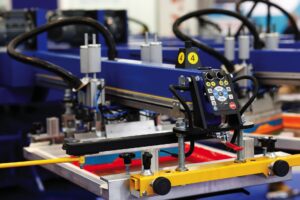
Different decorating techniques work best with different kinds of jobs. A high-output screen-printing auto, for example, works great for larger orders. For smaller orders? Not so much. Photo by gen_A – stock.adobe.
Starting with just one day keeps the exercise simple and removes the temptation to overanalyze.
When you’re done looking at orders produced, try capturing a few more basic data points, including:
- order size
- decoration method
- total order revenue
- estimated labor time to produce the job
- any friction or bottlenecks you noticed.
Even a snapshot as quick as this one can reveal patterns about how work actually flows through your shop. Remember, your shop’s identity is not what appears on your website or in your marketing materials. It’s revealed by what you actually produce.
If the majority of yesterday’s orders do not resemble the type of shop you believed you were running, you may be experiencing identity drift. This is a problem. Why? Because identity drift is expensive.
If you found this simple exercise useful, try expanding it. Pull the last 30, 60 or 90 days’ worth of orders. Summarize the data by decoration method in order to analyze:
- Total orders produced
- Total revenue generated
- Total productive labor hours
Now the real operating rhythm of your shop begins to appear.
Run Your Shop’s Math by Decoration Method
Yeah, I know. Math. Nobody wants to do math. However, the math behind your work is a powerful tool. Once you understand the kind of work you have showing up in your shop, the next step is to understand how much value that work creates over a given period of production time.
As you’re doing so, I want you to remember something. Two production days can consume the exact same number of hours and yet generate dramatically different levels of revenue. The difference between the two is where the idea of Value Per Hour comes in.
By way of an example, let’s look at a hypothetical automatic screen-printing scenario similar to the one we employed in Part 1 of this series. To start out, imagine a press runs 10 orders of 30 shirts each at $15 per shirt over the course of a 7.5-hour workday:
Total revenue: $4,500
Total productive labor hours: 7.5 hours
Value Per Hour = $4,500 ÷ 7.5 hours = $600 per hour
Now imagine running that same press for the same amount of time printing three orders of 900 shirts each. Even if you drop the price to $7.50 per shirt:
Total revenue: $20,250
Total productive labor hours: 7.5 hours
Value Per Hour = $20,250 ÷ 7.5 hours = $2,700 per hour
Both scenarios expend the same production time. Both keep your shop equally “busy.” However, the value created is dramatically different. This difference is key to the routing decisions you should be making.
Routing Your Apparel Decorating Shop’s Work Intentionally
The example above highlights an important lesson. Profitability is not just about keeping the shop busy. It’s about routing work through the right production channel.
Larger orders belong on high-capacity equipment, such as automatic presses. Smaller runs may be better handled using a manual press or via a digital workflow, such as direct-to-garment (DTG) or direct-to-film (DTF). Failure to employ the right tech for the right job at best leaves money on the table. When a shop routes its work based on habit rather than economics, production hours end up being consumed without creating enough value.
This is where many shops get stuck. Their schedules stay full. The teams work hard. But the numbers never get any better.
 Here’s an uncomfortable truth. Too many shop owners have never gotten around to calculating the kinds of numbers I’m talking about. They assume if their presses are running and their employees are busy the business must be doing fine as well. When they run the math, the results are often surprising, as it turns out all too many of the jobs they’re been doing consume large amounts of production time but generate very little in the way of revenue. While some equipment is consistently engaged in high-value work, other workflows are quietly dragging down their shop’s overall performance.
When shop owners see these patterns, when they start running the numbers, something changes. Production decisions stop being based on habit. They start being based on economics.
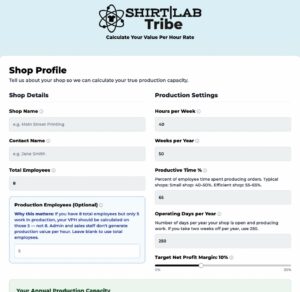
If you want to explore this concept further, I recently built a simple online tool designed to help shop owners quickly and easily test their numbers, the Shirt Lab Value Per Hour Calculator. The purpose of this tool is to help owners answer a few key questions:
- How many productive hours does your shop actually have each year?
- How much value does each production hour have to generate to cover your overhead and reach your profit goals?
- Which of your production methods are creating the most value?
- Which ones may be dragging down performance?
Instead of guessing, you can experiment with your own real-world numbers to see how different production decisions provide different results.
You can access the free tool here: shirtlabvalueperhour.com. Start by entering a few basic numbers from your shop. You might begin with yesterday’s production. After that, expand your analysis to a week, a month, a quarter, an entire year. By conducting these kinds of analyses, it doesn’t take long for many shop owners discover the path to establishing a strong business is not about working harder. It’s about understanding how value is created by the production processes they’re employing.
Conclusion: Knowing What Creates Value
The decorated apparel industry is not broken. However, the assumptions on which many shops were originally built are no longer in synch with the times. The shops that are going to thrive over the course of the next chapter of this industry will not simply stay busy. They will have a full understanding of their numbers. They will know which work creates value, which work consumes it and how to route production accordingly.
 Value Per Hour provides a clear lens by which to see that reality, making it the first step toward a competitive advantage.
Marshall Atkinson is a veteran designer, custom apparel decorator, business coach and principal of Atkinson Consulting, (marshallatkinson.com). He is also the publisher of the “Midjourney: Elevating Print Creativity” online newsletter (midjourneyexperience.com), which covers the latest in generative AI, and author of the online book “2026 Thinking: How Businesses Will Win, Stall, or Fail in 2026.” To download a copy of the book free-of-charge, go to https://qrco.de/2026Thinking. To access the Value Per Hour online tool discussed in this article, go to https://shirtlabvalueperhour.com. To read Part 1 of this two-part series, click here.