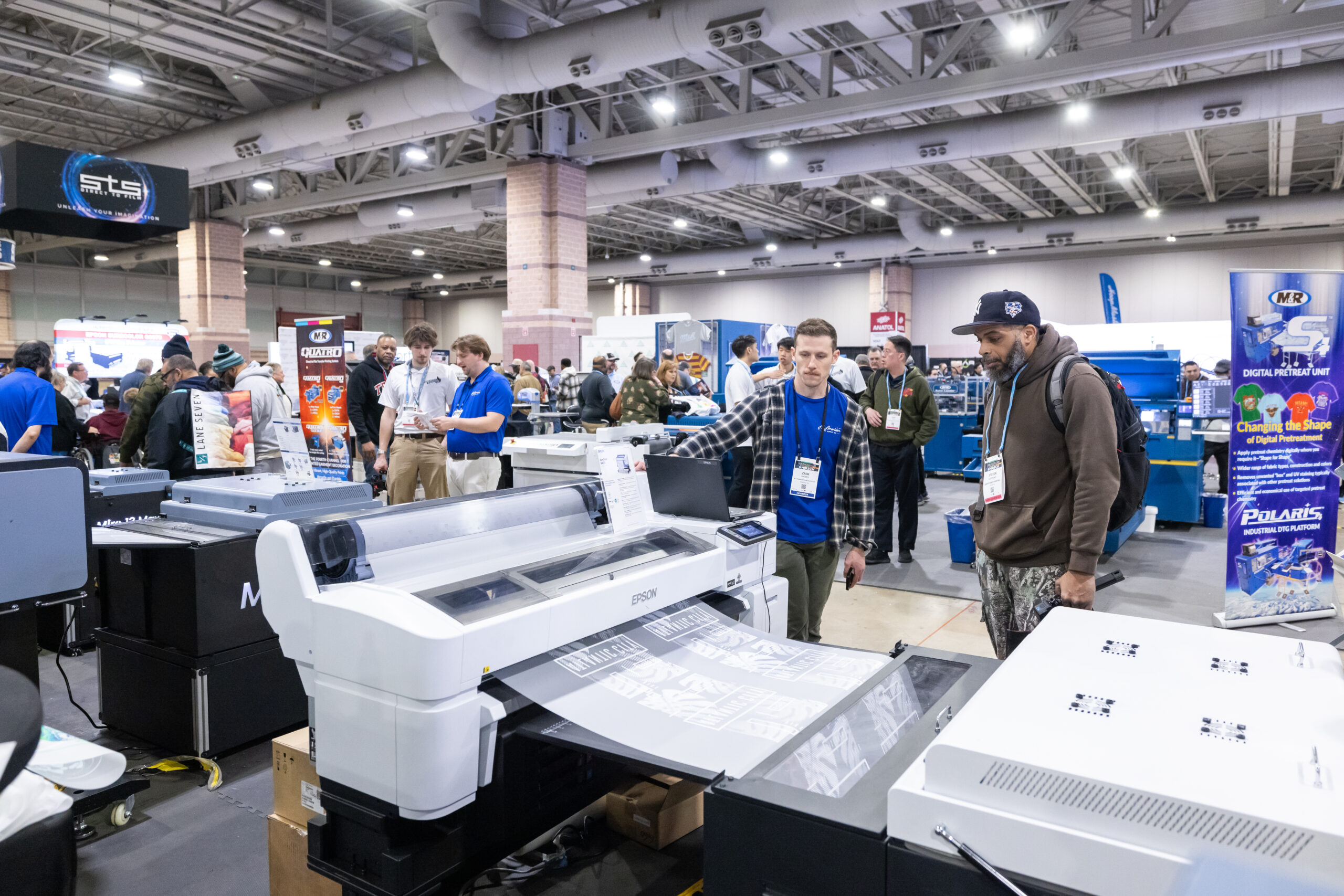
Direct-to-film (DTF) printing has certainly taken the garment decorating industry by storm over the past few years, to the point the honeymoon of the “be-all-and-end-all” of garment decorating technology can now said to be slowly ending. Clearly this technology is here to stay and is an excellent decoration method. At the same time, more and more businesses are also now seeing it as “another” decorating tool as opposed to a replacement for their current methods of applying ink to fabric. Case in point, the renewed interest in direct-to-garment (DTG).
The Biggest Advantages of Outsourcing DTF Transfers
One of the great things about DTF decorating is the low barrier to entry. Pretty much anyone can start out with just a singular—and critical—investment in a good quality heat press, and then contract out the actual transfer printing. Catering to the latter market is what feels like the nearly unlimited number of custom DTF transfer vendors these days. That said, do your homework. Not all transfer providers are equal. Try more than one vendor printing the same graphic and compare. You’ll quickly see what I mean.
Along these same lines, don’t go the cheap route on a heat press. A low-end heat press may doom your new venture from the start. Uneven heating, difficult-to-control pressure settings and inaccurate heat readings will invariably give you less than desired results. A $200 or $300 heat press will be a purchase you regret. A good quality heat press will start in the neighborhood of $1,200. However, it will be an investment that pays dividends for years to come. Bottom line: Buy a high-quality heat press if you want to be successful in this venture.
As a screen printer, my greatest surprise when first introduced to DTF transfers was their washability. My assumption—and the assumption of many screen printers—was that DTF would be a novelty decoration with a limited lifespan. Not so. The standard in the industry for decorated apparel is 50 washings with no degradation of the graphic. High-quality DTF transfers far surpass 50 washings with no impact on color, adhesion or the stability of the transfer on the fabric.

Another advantage to DTF transfers is the variety of items you can decorate. Virtually any fabric can be used to apply transfers, from 100 percent cotton to 100 percent polyester. By contrast, some other decoration methods, like sublimation, can be limited in terms of the fabric options you’re able to work with. Additional steps may also be necessary depending on the technique you’re using. Case in point, DTG. With DTF transfers, the only real variables are the heat-press time and temperature.
DTF also is an excellent method for decorating hats. Do I even need to remind you to buy a high-quality hat press? An especially interesting application has been not only applying a transfer to the front of a hat, but adding a logo using DTF to the mesh side of a hat as well. And you’re not just limited to garments, either. Porous materials like cardboard presentation boxes or notebooks are also all great candidates for DTF. If it’s porous and you can fit it in a heat press, it will likely work.
Finally, the number of colors you can offer is endless. Screen printers’ bread and butter is one-, two- and three-color work. Beyond that, many screen printers do not have the technical expertise to do things like photographic reproductions or multiple color graphics.
Compounding the problem is the fact the lower quantities many customers choose to order these days no longer justify the time and expense involved in setting up multiple screens. It’s a simple fact of life that while the number of decorated apparel orders continues to increase, the size of each order is down, a situation that plays right into the hands of DTF transfers.
What Are the Drawbacks of DTF Printing?
Let’s be honest, not everyone loves the feel of DTF transfers. Screen printers, in particular, tend to prefer the feel of plastisol on cotton. That said, consumers, i.e., those same customers that make it possible for you to pay your bills, tend to be much more forgiving of this decoration method than we decorators. Show a sample or two to some of your current customers and see what they have to say.
Another perceived disadvantage to creating your own DTF transfers in-house (one created almost entirely in the minds of potential DTF printing machine purchasers, I might add) is the idea you should be able to just walk away and forget it at the start of each production run. Countless decorators have said to me their goal is to turn on their DTF printers when everyone is walking out the door at night and then collect a batch of perfectly printed rolls of film in the morning.
Unfortunately, while that might work in a perfect world, none of us lives or works in a perfect world. Once a DTF printer is running, you can in fact walk away in order to attend to some other tasks. However, you still need to keep an eye on things. Some machines, for example, require you to manually add adhesive powder to the powder/shaker/dryer a few times per hour. Others will have a larger hopper that can be filled and run for several hours at a time, but still need to be watched. Either way, ultimately things can and sometimes will go wrong, in which case if you’re not there to monitor the situation you may end up wasting hours of film and ink.
One of the great things about DTF decoration is the fact the barrier to entry is so low. Get yourself a quality heat press, source a reputable custom transfer provider, and you’re pretty much ready to go! Photo courtesy of Impressions Expo
How to Start Selling DTF Without Owning Equipment
As with any decoration method, I recommend building a customer base first. Remember, pretty much any decoration method can be easily contracted out to another decorator when you’re still just starting out. As is the case with the many DTF suppliers out there, make it a point to try out more than one decorator. Beyond that, invest in that good quality heat press, find a great DTF transfer vendor, and you’re in business.
Note, if you own a DTG printer, you can also try and test the waters by printing out your DTF transfers on the printer you already have using cut sheets as opposed to rolls. In fact, many decorators start out this way, i.e., by purchasing a DTG or hybrid DTG/DTF printer if they expect only limited use in the beginning stages of their DTF venture. All DTG printers with white ink are capable of printing DTF transfers.
In order to successfully apply the transfers you either purchase or create, be sure and consult with the manufacturer or supplier for the correct process details. You’ll likely end up using medium pressure on your heat press and pressing the transfer at a temperature somewhere between 275-325 degrees F, depending on the fabric (less for polyester, more for cotton). Following the initial press, peel the transfer, lay a sheet of buckram (course) fabric on top of the transfer and then press again for 5-10 seconds.
When Is It Time to Invest in a DTF Printer?
Deciding if and when it’s time to buy some DTF printing equipment of your own starts with a close look at the costs involved. In fact, the cost of contracting out your transfers will vary widely. An average might be in the $4.50-per-square-foot range. But your preferred supplier might end up being higher or lower than that. The price may also depend on quantity and turnaround time. If you’re already buying transfers, you know where you are on this number.
Besides the cost of the equipment, labor, etc. when doing your transfer printing in-house, the cost per square foot for film, ink and adhesive powder will range between $0.50-$0.80 per square foot of finished transfers. Printing cut sheets on a DTG printer, on the other hand, will be more in the $1.25-$1.50 range. (These are average costs for professional printer packages.) No matter what you’re paying for finished transfers, printing your own will offer substantial savings in terms of cost.
Questions to Ask Before Buying a DTF Printer
When talking to a prospective DTF supplier the first question you’re going to want to ask is, “Could I speak with a couple of your customers who own this equipment?” Granted, the supplier in question will invariably give you their absolute best customers. But isn’t that who you want to talk with anyway? In the end, no one can tell you more about a DTF printer package than someone already using it.
Other questions you’re going to want to consider are, “How much space will this printer and shaker package take up on your floor?” and “How much space will you need around the outside of the equipment for servicing?” When thinking about a potential workspace, be sure and allow plenty of room for replacing film and ink in the printer. Most load from the back, but front-load film and ink options are also available.
The many different DTF presses currently available offer a wide range of features and capabilities. Photo courtesy of Impressions Expo
In addition, there are various environmental considerations to keep in mind with DTF printers. Truth be told, it never ceases to amaze me how many new decorators say no one bothered mentioning any of these kinds of issues before they bought their equipment given how critical a consideration this is if ever you decide to start printing transfer on your own. In a nutshell, you must have 40 percent or more humidity in the room kept at all times at normal office temperatures. A cold-in-winter or hot-in-summer warehouse will not be your friend when it comes to keeping your equipment running—just the opposite! It will cause you nightmares with clogged lines and replaced print heads.
Here’s another easy one to figure out. What size door openings are you going to need to bring your new equipment to its chosen spot on the production floor? Some powder/shaker/dryers require an overhead door or double doors to move them to their final location. That said, there are some single interior doorway options available as well, which will allow you to make an installation work even without a large doorway.
Along these same lines, what’s the electrical capacity in your facility? Many powder/shaker/dryers systems require a combination of 220v and a 50-amp connection. Others are 110v and require only a standard 20-amp connection. Ask about the electrical requirements of the system you have in mind up front in order to avoid wasting your time looking at a machine you’ll never be able to use.
If you’re a screen printer you’re likely already venting a conveyor dryer or two out through the roof. Some powder/shaker/dryers for DTF require similar venting. At the same time, more and more of these kinds of units are now coming with a built-in filtration system, with replacement of these filters every few months. Build that into the cost of operating this kind of system.
Here’s another question to ask those references I’m going to assume your supplier has provided to you with: “How long will it take for me to be up and running with this system each morning?” Your first thought might be that it will be the same for all machines. But that’s not necessarily the case. Yes, with some printers you’ll do a nozzle check and if all is clear, you can start printing. Others, however, might require doing a number of test prints to clear any inks that may have become mixed together overnight while the print head was capped. You need to know how much time you’ll need to commit to the startup process before transfers begin running down your powder/shaker/dryer belt.
Will it be two minutes? Or the better part of a half hour?
Training, Service and Technical Support Considerations
Finally, DTF remains a fairly new technology, making proper training essential. Is the training offered in-person, one-on-one via the internet, or are you simply given a set of videos? Is there any training at all? Ask those same references we discussed earlier the kind of training they received, and if they were satisfied. Customer support is crucial, no matter what kind of decorating tech you’re investing in.
Along these same lines, how will you be able to get your machine serviced, if necessary? Some machines will include a hands-on service contract direct from a manufacturer. With others, though, the support you receive will be in the form of a technician on the phone providing you with the requisite instructions while you do the actual work. Be clear up front what happens when something goes wrong. Discuss the details of whatever kinds of warranties come with the machine as part of this same conversation.
Understanding DTF Printer Speed and Printhead Costs
Assuming you like what you’ve heard thus far, you’ll want to know the realistic operating speed of the printer, commonly measured in square feet per hour. On a commercial machine you can expect anywhere from 70 square feet to many hundreds of square feet per hour. Take out your calculator and see if a particular machine will keep up with or exceed your production needs. How many transfers are you using every day? Will this machine print that many? Will it print more? Some of the very small 12-inch-wide printers currently on the market can be pretty slow; which may in turn mean it makes more sense to keep outsourcing your transfers rather than try and make money with just the few transfers you’re going to get per hour.
Similarly, how many print heads does the machine have? More print heads generally means greater speeds and more color options. However, the more print heads you have, the more expensive it will be having to replace those print heads when the warranty runs out. Print heads typically cost $1,500-$2,000 each to replace, so keep that expense in mind. Sooner or later, you’ll be buying print heads, sometimes in less than a year (though if you take good care of your machine, it should only be every couple of years).
Is Bringing DTF Printing In-House Right for Your Shop?
Bottom line: there’s much to consider when deciding whether or not to take the plunge with a DTF printer package. Something to remember, though: one way or the other, DTF is here to stay. It’s likely only a matter of time before you, too, will want to join the party!
Terry Combs is a 45-plus- year veteran of the garment decorating industry, having managed production shops large and small across the United States. Terry is also the co-host of the 13-year running industry podcast, 2 Regular Guys, and is in sales and training with the New Jersey-based DTF and DTG equipment and materials supplier Equipment Zone.