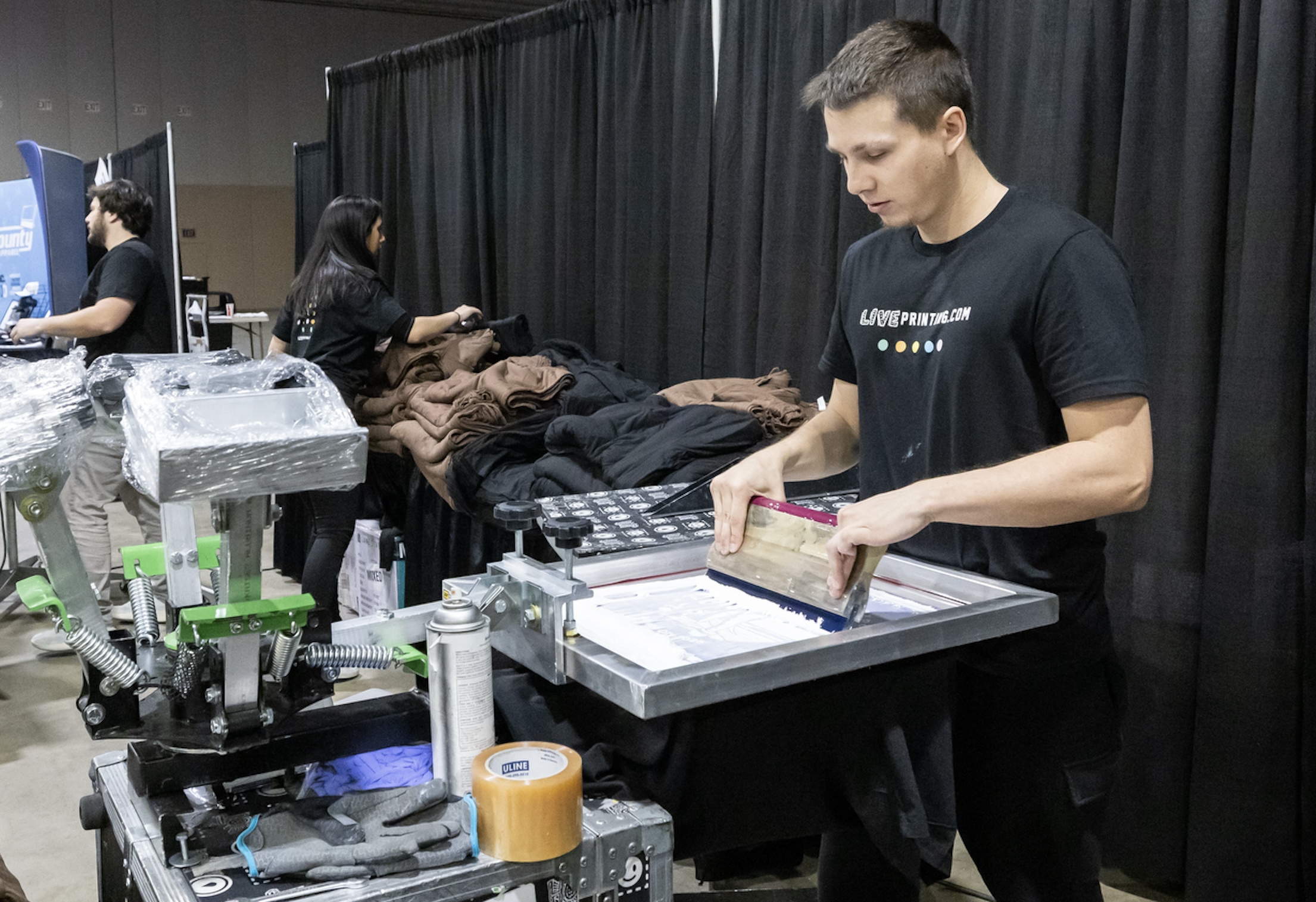
According to a newly released report from the market-research firm Global Growth Insights, the worldwide manual screen-printing press market was worth $83.98 million in 2025 and is projected to reach $87.51 million by the end of 2026. Longer term the market is forecast to $126.73 million by 2035, exhibiting a CAGR of 4.2 percent over the course of the forecast period.
According to the analysts at Global Growth Insights, the demand for manual presses will remain stable for the foreseeable future in the textile decoration, promotional printing, specialty graphics, garment customization, signage, and small-batch industrial printing sectors for a number of reasons.
“Manual equipment remains attractive where production flexibility, manageable capital requirements and operator control outweigh the need for high-speed automation,” the company says. “Demand for manual screen-printing machines is supported by customized apparel, promotional merchandise, sportswear, uniforms, specialty graphics and short-run garment decoration. Commercial applications account for approximately 76 percent of overall market demand, while residential and home-based printing represents nearly 24 percent [of demand] as entrepreneurial and small-scale customization activity expands.”
Benefits of Manual Screen Printing When Apparel Decorating
The report goes on to emphasize manual screen printing machines remain important for businesses requiring flexible multicolor production, manageable equipment footprints and operator-controlled printing. It adds the four to six-stations segment represents approximately 39 percent of type-level demand, while six to eight-station machines account for nearly 25 percent of demand as professional decorators require greater color capacity and improved workflow flexibility.

“A distinctive feature of the manual screen printing machine market is the continued commercial relevance of operator-controlled presses despite broader printing automation,” the report’s analysts say. “Approximately 42 percent of smaller print operations favor manual systems for flexible order scheduling, while nearly 28 percent use them alongside digital equipment to accommodate specialty inks, limited editions, and mixed production requirements.”
Looking ahead the report notes hybrid production strategies are also reshaping purchasing behavior. Per the report, screen printing increasingly operates alongside digital garment printing, heat transfer, embroidery and specialty finishing. Approximately 37 percent of established decorators employ multiple decoration technologies, allowing manual screen presses to handle jobs requiring specialty inks, high-opacity layers, metallic effects, textured finishes, or economical repeat production.
Sustainability A Manual Press Market Driver
“Sustainability considerations are influencing equipment utilization as well, with about 29 percent of professional users placing greater emphasis on reducing setup waste and controlling ink consumption,” the reports says. “Compact machines are [also] gaining visibility among micro-enterprises, educational workshops, maker spaces and online merchandise businesses, while larger manual presses retain demand from commercial operations requiring greater color flexibility and multiple loaded platens.”
In terms of the challenges manual screen-printing press manufactures face, the report cites labor costs and competition from direct-to-garment (DTG), direct-to-film (DTF), transfer printing and increasingly sophisticated automated screen-printing tech.
“Around 27 percent of commercial operators identify manual labor intensity as an operational limitation when production volumes increase. The restraint is strongest for highly variable, low-quantity personalized orders where digital systems can eliminate screen preparation. Manual machines nevertheless maintain competitive advantages in repeat garment production, specialty inks, high-opacity graphics, textured effects, and applications requiring direct operator control, keeping them relevant within diversified printing operations,” the report says.
Commercial Printers Represent Majority of Demand
Regionally, the North America accounts for approximately 29 percent of the global manual screen-printing machine market. “The region benefits from a mature ecosystem of apparel decorators, promotional product suppliers, schools, sports organizations, independent brands, and customization businesses [with] approximately 57 percent of regional equipment demand is linked to professional commercial users.”
Outside the North American market, Europe represents 25 percent of global, while the Asia-Pacific represent 35 percent of demand. For a complete copy of the report, click here.