A case study in knowing what you’re great at – and partnering for the rest.
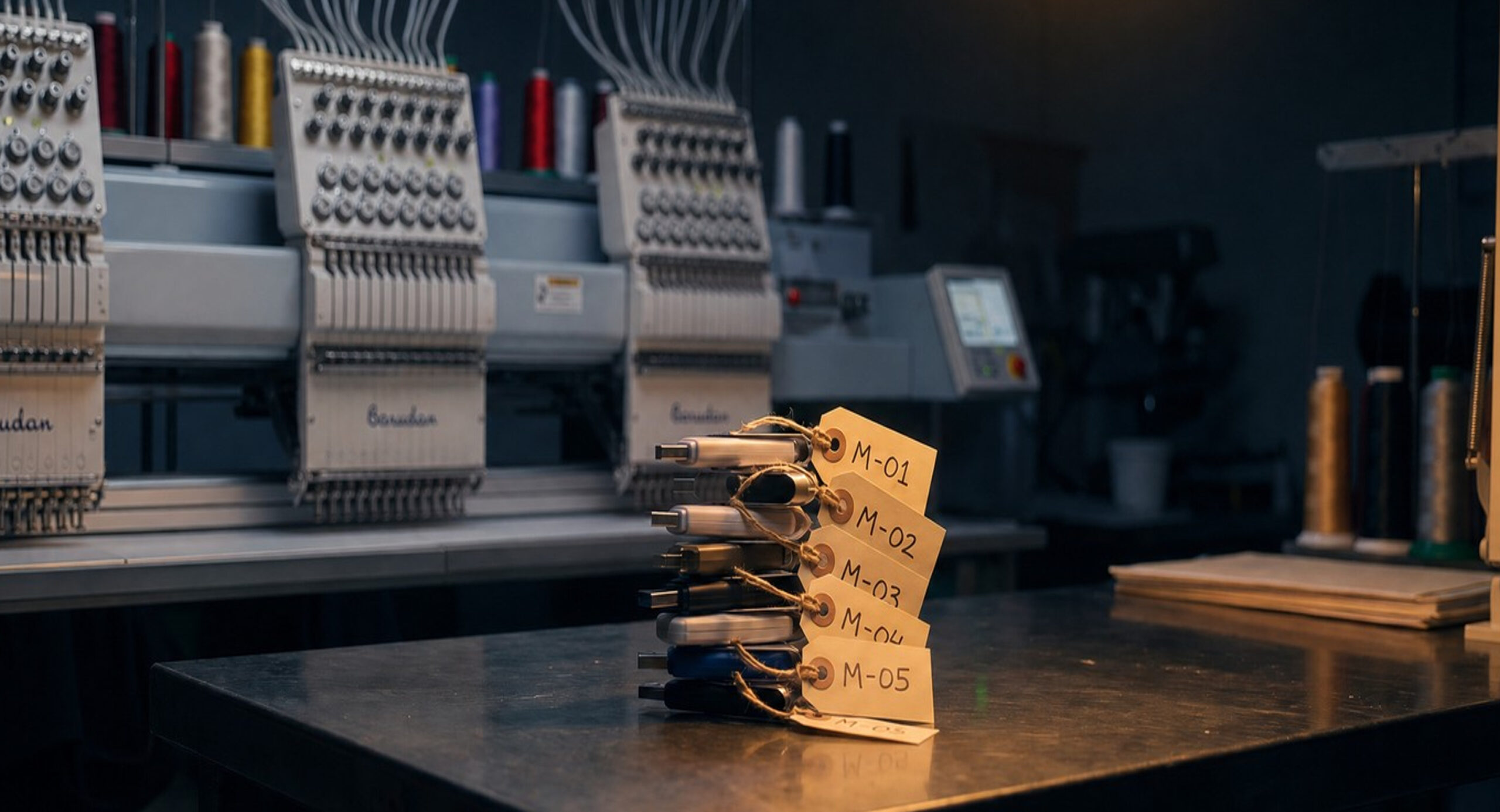
There’s a ritual in embroidery shops that nobody romanticizes: loading tomorrow’s designs onto USB drives, one per machine. Thad Badowski, Chief Engineer at Barudan America, recalls one owner who did it until 3 a.m., slept three hours, and drove back at six to hand the drives to her first shift. Most of the industry still works this way.
“We had a nine-needle single head machine when I started in ’94,” says Bob Stone, Barudan America’s Vice President of Sales. “The best it would do was 750 stitches a minute. Now everything’s designed for production.” The iron stopped being the bottleneck long ago. What’s left is everything around it: getting the right design to the right machine with the right thread, and knowing what happened next.
The Lamborghini Doesn’t Do Whiteboards
Barudan inherited a philosophy from founder Yoshio Shibata that never chased volume. “We’re more like the Lamborghini,” Stone says. “We make the absolute best machine we can.” That focus breeds famously loyal customers, but it also kept Barudan deliberately out of software. Its BNet system handles design delivery; shop management was always someone else’s problem. Customers kept asking for it anyway.

The Epiphany
Badowski had been pushing Barudan Japan for an API when a longtime customer raved about a shop-management program from England called Tracker. A conference call later, the pieces clicked. “It was the perfect opportunity to marry our API with the customer,” he says.
Building software in-house would have meant battling time-zone, priority and language barriers with developers in Japan. “We need to concentrate on sewing and embroidery,” Badowski says, “and let someone with more expertise deal with it.” The partnership “saved us a ton of time and development,” and Tracker’s integrations with SAP, Microsoft Dynamics and other ERP systems are clearly owned and maintained.
The Stigma You Can’t Hold in Your Hand
The cultural case was harder. “It’s a very traditional industry,” Stone says. “There’s a stigma tied to software because you can’t see it. You invest a five-figure sum in an embroidery machine and you can see it right there.”
Badowski often sees shops “not ready for their own success”: a few machines, inventory piled on the floor, containers in the parking lot. That’s when they’re ready for Tracker. Shrinking order sizes raise the stakes. One Pacific Northwest apparel brand found it was running two-head jobs on six- and eight-head machines, and bought two-head machines for small runs.
“It’s Changed Everything”
At a large sports licensing apparel manufacturer, production runs smoother, output is up and mistakes are down. “They know where their orders are,” Stone says. “You can see, minute to minute, what you’re producing. I don’t understand how anybody would not want to know that.”
The demo showstopper is color management: pushing thread colors from screen to machine, even on older heads. Visibility also saves capital. “Sometimes people add machines where they probably don’t need to,” Stone says.
The Philosophy That Holds It Together
“I know it’s a cliche, but it’s taking care of the customer,” Stone says. “I would hate to walk away from a customer saying, ‘We can’t help you.'”
The moral is simple: a great machine delivers its full value only when the workflow feeding it is just as good. Barudan builds the Lamborghini. Tracker builds the road. And the shops that run both are rested at 6 a.m., with every job routed, every color queued, and every head doing exactly what it was built to do.
Please click the link for the full story: https://www.trackmybusiness.com/blog/barudan-tracker-machine-partnership