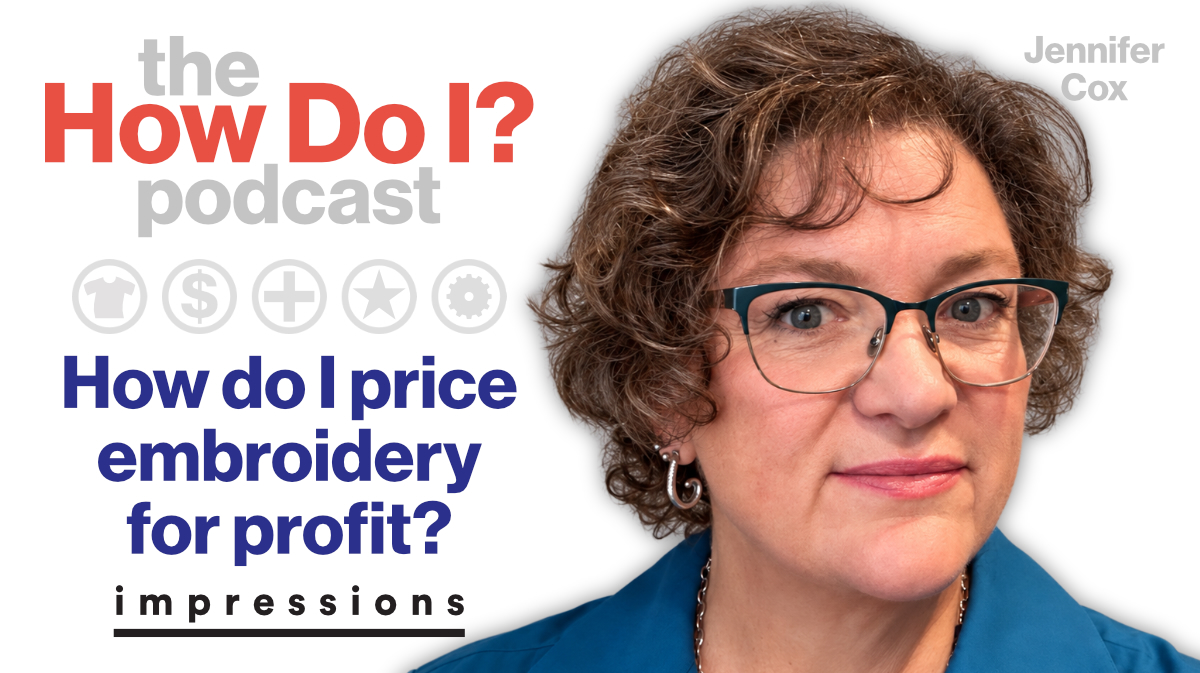
In a preview companion article for the yet-to-be-released second episode of the “How Do I?” Podcast, guest Jennifer Cox of the National Network of Embroidery Professionals explains how important it is for commercial custom embroidery shops of all sizes to price their work correctly in order to make the most of their production capabilities and maximize profits.
Keep an eye on this space for the soon-to-launch podcast itself!
How confident are you in your pricing strategy? Jennifer Cox with the National Network of Embroidery Professionals (NNEP) joined me recently on the “How Do I?” podcast to discuss the fact an awful lot of shops out there don’t have a solid pricing strategy. Instead, they have a pricing “habit.”
As part of the “NNEP State of Embroidery Pricing 2026” report published this past summer, 545 shops took the NNEP Pricing Diagnostic to see how their shops fared. Only 25 of them scored in the top tier. That’s 4.6 percent. With this mind, Jennifer and I discussed what these numbers mean and what shops can do about them.
What Is a Pricing Habit When it Comes to Embroidery?
According to Jennifer, a pricing “habit” is the number you fall back on because you never built anything else. Maybe someone handed you a stitch-count chart 20 years ago, or you decided to use someone else’s pricing grid as your own and charge a few cents less. You’ve been playing with that number ever since.
Jennifer says the problem with this approach is you can’t tell you whether the order you entered into the system, or the one from 10 orders ago made you any profit. Take a real order in your shop today. What are your actual total costs? How much time did it take to run? After the job shipped, what was the total net profit?

To answer these questions, you need to do the math.
Why Don’t Embroidery Shop Owners Do the Math?
If you think about it, our industry never really teaches shop owners how to build pricing matrices correctly. Sure, you know the cost of the blank, digitizing and shipping. But what about salary, labor and overhead? How are these factored in? Do you know the exact profit number for every order that goes through your shop? Are you happy with it?
Jennifer compares how all too many custom embroiderers—and custom apparel decorators in general—work to a McDonald’s franchise. McDonald’s knows to the fraction of a penny what it costs to put a soda in your hand. A car dealer knows what each car costs to sit on their lot. They make money because they know those numbers.
Embroidery shops typically start differently. Somewhere along the line, you bought a machine. You fell in love with the process. Then someone said, “Hey, you could make money doing that.” So, you started selling before you built an actual business.
The result, as Jennifer says, is not a talent problem. It’s a system gap. You can fix this.
Are You Paying Yourself For Your Embroidery Work?
Something else—according to Jennifer’s research, more than 70 percent of embroidery shop owners don’t take a salary.
Let that sink in for a moment. If you’re not paying yourself, is that because your pricing doesn’t include you? Are you essentially working for free? Worse yet, your future will pay an even higher price, as you are not contributing to Social Security or retirement. (Speaking of which, selling your business is not a retirement plan.)
To be clear, Jennifer is not trying to make anyone feel bad. Acknowledging this fact is purposeful, as it’s the first step to fixing the situation.
Should You Quote Stitch Counts to Embroidery Customers?
No. According to Jennifer, “A stitch count only measures the design. It doesn’t measure the order.”
Think about a restaurant for a moment. You want to know your dinner selection will cost you $32. You don’t need or want to know the cost of the gravy. Your customer is the same. They want to know the final price, when it will be delivered and whether it will look fantastic. That’s it.
Jennifer calls everything else “pricing noise.” Pricing noise is the stitch counts, thread types and layer talk that confuses customers and stalls the sale. “Twenty-four polos with your logo at $62 each, ready on the 14th” makes sense to a buyer. A price per 1,000 stitches doesn’t. Most of the profit originates with the garment markup, not the decoration.
Keep the stitch count as order input, not as a customer-facing pricing method. Art, digitizing and shipping are fair add-ons. Just check your state’s tax rules.
What Are the 5 PRICE Gaps in Commercial Embroidery?
In the “NNEP State of Embroidery Pricing 2026” report, Jennifer outlines five pricing drivers you should know. These spell out the acronym PRICE, making them easier to remember. In the report, a “gap” means a shop scored low on a particular driver. In the report, four of the five drivers showed gap rates above 50 percent.
| PRICE Driver | What It Means | Shops With a Gap |
| Production Cost | Your shop rate: what it costs per hour to open the doors, like the hourly rate your mechanic charges | 66.8% |
| Intended Profit | Setting a profit target for the order before you quote it | 60.0% |
| Real Labor | Every minute you and your staff touch the order | 58.5% |
| Capacity Pressure | Pricing for limited machine time, rush jobs, and overtime | 53.0% |
| End Customer Value | Pricing based on what the customer is worth to your business | 26.8% |
With embroidery jobs, it’s all about how many runs per hour you can complete. When determining capacity, remember that machines aren’t sewing the full 60 minutes of an hour. Jennifer estimates 50 percent to 60 percent of each hour is spent on actual stitching. The rest of the hour is spent on changeovers, thread breaks and other work.
Jennifer says it’s also important to keep in mind the fact there are no less than 22 touch points on a typical order. If you only use the stitch count for pricing, that only covers about seven. Who pays for the other 15?
In the report, the good news is what it discovered in the area of End Customer Value. Only 26.8 percent of shops reported had a gap there. In other words, most shops know which customers are worth more to their businesses and price them accordingly.
The bad news is what the report discovered in terms of inside costs. Production cost, labor, profit targets and machine time all showed gaps above 50 percent. In other words, you might have great relationships with your customers, but don’t have a true handle on your shop’s numbers.
What If You’re Afraid to Raise Prices on Your Embroidery?
Fear lives where the numbers aren’t—which is Jennifer’s point.
She gives the example of a shop with a customer who has been coming to it for more than five years and orders a couple of hundred pieces every year. In this shop, they have kept the pricing for the embroidered garments consistent that whole time. Meanwhile, the garment cost has risen by about $3 a unit. The shop is eating the increase, and the customer has never heard a word about it.
With this in mind, Jennifer has two questions about not increasing prices:
- What are you afraid of losing?
- What is it costing you to keep pricing the same?
Knowing your numbers allows you to stop being controlled by fear and instead be driven by facts. Need a price increase to maintain the same profit margin? Ok, raise your prices and give them to your customers without apologizing.
In what may be one of the single best tips in the entire episode Jennifers suggests that when working with a customer you state the price and then move straight on to, “When do you need these by?” Don’t make the price the question. The only question left to answer is the delivery date.
What Should You and Your Embroidery Shop Do Right Now?
Jennifer provides some specific homework assignments decorators can use to both fine-tune their pricing in increase profitability:
- Read the free State of Embroidery Pricing 2026 report.
- Take the free NNEP Pricing Diagnostic. It takes about the minutes.
- Review a few of your previous or current orders and examine them for profitability.
- Rethink your pricing with net profit in mind.
- Watch the full interview on the Impressions YouTube channel. [Episode URL]
You can’t fix what you haven’t measured. Don’t quote stitches. Price your orders with profit in mind.
Again, watch this space for information on when full podcast launches in the near future!
Marshall Atkinson, host of the “How Do I” podcast, is a veteran designer, custom apparel decorator, business coach and principal at Atkinson Consulting, (marshallatkinson.com). He is also the publisher of the “Midjourney: Elevating Print Creativity” online newsletter (midjourneyexperience.com), which covers the latest in generative AI, and author of the online book “2026 Thinking: How Businesses Will Win, Stall, or Fail in 2026.” To download a copy of the book free-of-charge, click here.