Walk through almost any decorated apparel shop on a busy Monday morning, and you’ll likely see the same scene: production managers juggling rush orders, operators waiting on garments and machines sitting idle while someone searches for missing information.
Most shop owners assume these bottlenecks are simply part of the business. However, many are symptoms of a single overlooked issue—a production schedule that isn’t keeping pace with the complexity of today’s embroidery operations.
Let’s look at the different ways shops handle their scheduling and why some methods might be holding your business back.
1. Why Manual Production Scheduling Can Hold Custom Embroidery Shops Back
In manual scheduling, a planner looks at a stack of orders for the day and relies on their own experience, intuition and a few basic rules of thumb to assign them.

For example, they might give the trickiest jobs to the most experienced operators or assign the larger orders to the biggest machines. They might try to group orders by thread color to save time or estimate how long a job will take by doing some quick mental math based on stitch counts.
The Catch: This method works reasonably well for smaller shops—up to about 20 machine heads. But beyond that, it’s simply too much information for one person to juggle effectively.
Manual scheduling also puts a huge amount of stress on the planner. Because everything is done by hand (or kept in someone’s head), there are rarely formal records of who is doing what or how long it should take. This often leads to a chaotic environment where management is constantly putting out fires, machines sit idle between jobs, and there’s a lack of clear, standardized procedures.
2. Why Whiteboards and Production Calendars Don’t Solve Scheduling Problems
This is essentially the manual approach, just displayed differently. Some shops like to write the orders with an estimated start time and estimated run time on a whiteboard for everyone to see.
Other similar computer-based systems rely on the production manager to manually assign each job to a machine block of time on a digital calendar. These kinds of systems may use a barcode system to track the time an order took. But they do not choose the machine or calculate the time an order should take—instead leaving that up to the manager.
The Catch: While this approach helps with visibility, it doesn’t improve the scheduling process itself. It still relies on human guesswork and suffers from all the same drawbacks as the manual method.
3. Why Generic ERP Scheduling Falls Short for Embroidery
Many larger shops use an enterprise resource planning (ERP) system, like Microsoft Dynamics 365 Business Central. These are comprehensive systems designed to manage all aspects of a business and often include scheduling tools that work wonderfully for traditional repetitive manufacturing, like making identical plastic parts or stamping metal.
Most systems use a standard formula: Total Time = Setup Time + (Time per Item × Quantity). This works perfectly when a process is highly consistent and predictable. In the apparel decoration world, for example, processes like heat pressing or direct-to-garment (DTG) printing fit this mold well. Others use variations of the standard formula and/or various hacks. The results are no better.
The Catch: Embroidery and screen printing are incredibly complex and often short run. In embroidery, for example, there are dozens of different variables that affect how long a job will take—things like choice of machine, product type, stitch count, thread changes, fabric type and hooping time. General ERP software simply ignores these variables.
Using standard ERP software to schedule embroidery is like trying to use a map of New York to navigate downtown London. It might look professional, but it’s the wrong tool for the job, and it often results in schedules that are even less accurate than doing it by hand.
4. Building a Better Custom Embroidery Shop Production Schedule
In light of the drawbacks of the systems outlined above, it becomes clear an effective scheduling system for later embroidery shops must do four things:
- Publish a formal plan for the day’s work which matches the capability of the facility and workforce.
- Provide orders, supporting data and garments to operators so work can be completed as scheduled.
- Accurately calculate runtime and automatically assign orders to the best machine.
- Track actual production work so that results can be compared to the plan.
This level of precision requires a computer. A human simply can’t perform thousands of calculations and weigh every possible machine assignment in a matter of minutes: specifically, a purpose-built automated system built on the principles of industrial engineering (IE), the branch of engineering focused on optimizing complex systems, processes and organizations. Although IE is a widely recognized and growing discipline in much American manufacturing, it is used in only a handful of larger decorated products companies. With that in mind, the decorated apparel industry needs to employ the principles of IE to help optimize complex systems and processes, improve efficiency and workflows and reduce waste and costs.
5. Using Industrial Engineering to Improve Embroidery Shop Efficiency
The process of IE begins with a study of the work done by a trained embroidery operator that includes:
● Breaking it Down: An IE trained professional identifies and analyzes every step the operator takes to complete an order.
● Timing the Tasks: The IE professional then calculates the standard time required by an experienced, trained operator for each task, factoring in normal pauses and allowances for work fatigue and needed delays. This work is time consuming, building man hour rates for each different machine size and each product type so that every combination of tasks can be added up to a total.
● Creating a Formula: The IE professional then builds a detailed set of calculations for every unique combination of tasks. The result of this effort is a systematic way to calculate the total work necessary to embroider any product on any machine in a typical shop in the industry.
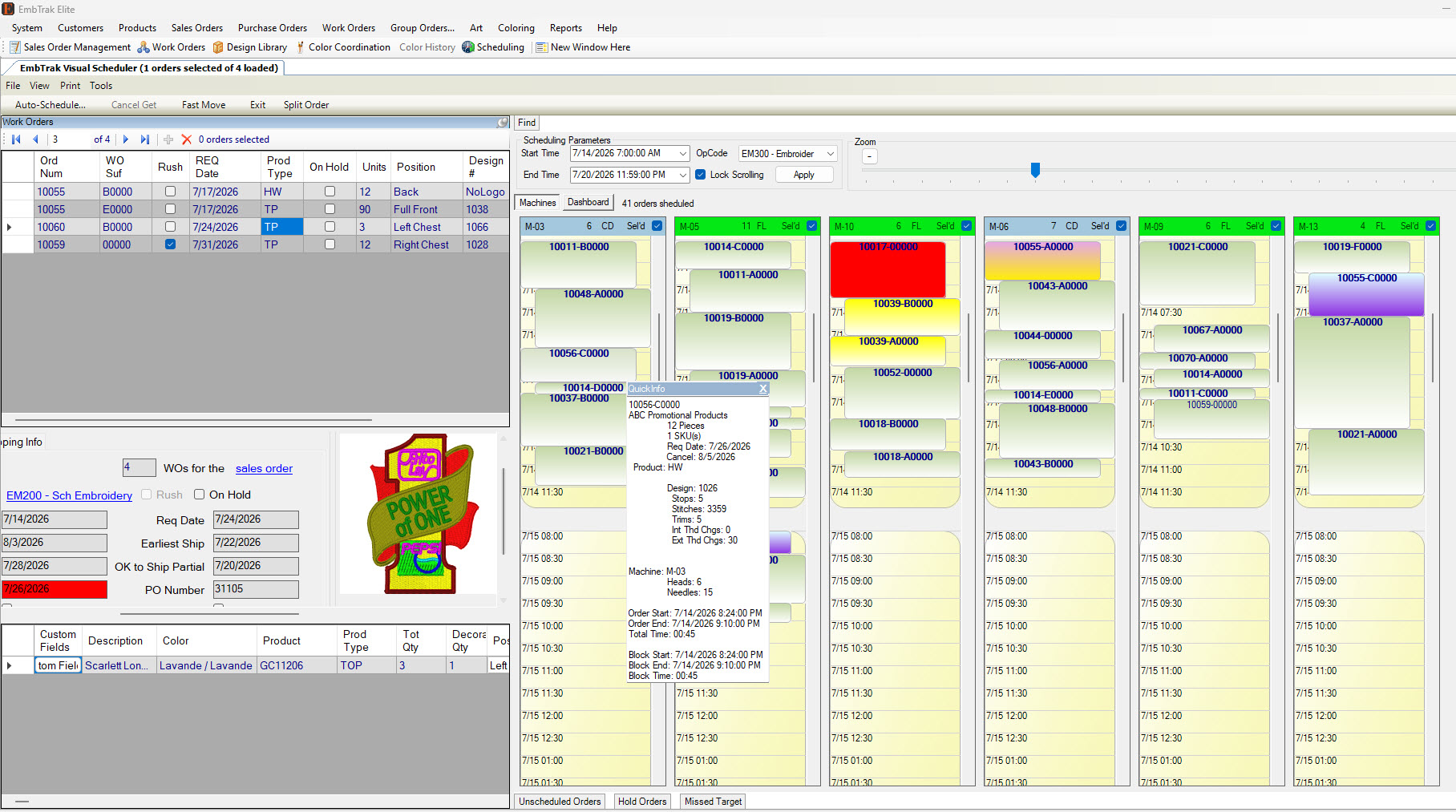
The results of this study are then used to create a purpose-built software system, such as my company’s EmbTrak Visual Scheduler system, to take over and create a daily schedule, or schedules for a shop.
To be effective, this software needs to be individually configured for each shop, from large operations with over a thousand embroidery heads to smaller shops with a dozen.
The software also needs to be set up to receive daily orders and add or edit decoration specifications, such as DST files, locations and threads. These orders can then be keyed into the system, or, orders can be imported from an ERP or sites such as Shopify, or over the internet or scanned from PDFs through an AI powered OCR.
6. How Automated Scheduling Optimizes Embroidery Machine Assignments
Third, the Production Plan is built each day with two distinct, but tightly integrated operations:
● The use of IE Rates to Calculate Order Runtime: Each day, the orders to be run are selected and submitted to the scheduler on the computer. Then the computer calculates the exact run time down to the second for each order.
● The “Smart” Assignment to the Best Machine: Then, the computer automatically assigns the order to the ideal machine, sequencing jobs to minimize thread changes and downtime.
The result is a clear, highly optimized daily production plan which lists in time sequence every order to be run by each machine for the day. It is a clear, timed list of work for each operator. In a well-run shop, this plan is generated once or twice a day. It’s distributed to the operators, who can then stay at their machines and focus on production. Support staff (runners) deliver the necessary garments and thread about 30 minutes ahead of the planned order start time, ensuring the operator never has to stop working to hunt for supplies.
Note, when a manual shop first begins using an IE based embroidery production plan it’s a good idea to start with the IE man hour target rates set at 80 percent of the industry standard. Your best operators will likely hit these rates as soon as they become familiar with the new system, while your newer operators may take a while to do so. Stay committed to the process. Issue the plan each day. Encourage your people. Let them get used to the forms. As they learn the use of the system, you can start turning the rates up. As their performance increases with the plan, shop productivity will increase.
7. Measuring Embroidery Machine Operating Efficiency
Note, an embroidery machine operating efficiency (OE) isn’t simply based on the machine itself. Instead, it’s calculated using the formula OE = (Machine Run Time/Total Available Time) X 100 percent to arrive at the percentage of time that a machine is running.
Because so much of the embroidery process involves operations which must be done while the machine is not sewing, the OE for many jobs runs in the 40- to 70-percent range, at best. As a result, eliminating unnecessary time spent on job changeovers and using runners to deliver thread and garments are easy ways to improve OE. As a result, with an IE based daily production plan, you will have a schedule that automatically attains 100-percent practical capacity, even if the rates are turned down to 80 percent. If you receive a rush order, you can also replace less urgent orders on the plan with rush orders having the same or less calculated run time and know that you can do the rush jobs.
8. How Better Scheduling Can Unlock Production Capacity
In one real-world test, a large shop had two of their own process control engineers do a full 30-day comparison of my company’s EmbTrak purpose-built system against their own internally developed scheduling software. Even though both systems used similar IE based run-time calculations, the engineers found that EmbTrak’s computer-based machine assignment algorithms system resulted in 18.3-percent more production—without adding any extra labor or machine time. They recommended the company buy the EmbTrak scheduling software.
When compared to standard manual scheduling, the improvements can be even higher, sometimes reaching up to 26-percent more production. That is essentially free manufacturing capacity. Bottom line: if your shop is still relying on manual scheduling or generic schedulers in ERP software, it might be time to ask: how much is your current schedule really costing you?
Don Brown is the author of “Automated Production Scheduling for Decorated Products” and president of EmbTrak, Inc. Prior to founding EmbTrak in 2000, he was an Army officer, a plant Cost Control Manager for a Fortune 200 manufacturer and ran a 45-man publishing house.