- Boost you brand and your bottom line by giving customers the personalized apparel experiences they want
- Print-on-demand models offer practical benefits for decorators, including reduced inventory risk and enhanced flexibility
- Printing inventory as orders come in reduces the risk of overstock and allows decorators to gauge demand for different designs
The last few years have turned the merch world upside down. With online access making event apparel widely available to anyone, exclusivity has diminished, forcing apparel decorators to rethink how to capture attention and drive sales. Customization, powered in large part by heat printing, has become a powerful differentiator. Live, print-on-demand (POD) activations that leverage heat printing allow customers to take part in the creation of their apparel, transforming a simple purchase into a memorable interaction.
By inviting consumers into the process, decorators tap into a deeper level of engagement that standard retail cannot replicate. A customized garment becomes a keepsake tied to a moment, a place or a personal experience. This emotional connection not only increases sales but also encourages repeated wear, extending the visibility and value of the brand long after the event ends.
At the same time, print-on-demand models offer practical benefits for decorators, including reduced inventory risk and enhanced flexibility. Print-on-demand models also allow decorators to charge premium prices for personalized products, as customers who participate in the creative process tend to be more invested in the result.
Heat Printing Custom Apparel Decoration Fuels Print-on-Demand Activations
If you’re planning to offer on-site custom apparel printing, a heat press will likely be at the center of your operation. With fast decoration speeds, consistent application and inherent portability, a heat press provides a flexible setup that enables real-time customization.

With that in mind, it’s important to be strategic in the equipment you choose. Start with portability. Look for features or accessories, such as a caddie or stand, that eliminate the need for external tables. The last thing you want is to have to spend hours hunched over an improperly sized work area that leads to discomfort and fatigue.
Next, consider reliability. Your heat press must be able to handle continuous use throughout the day while maintaining consistent temperatures and pressure. Equipment that can’t perform under sustained demand risks downtime, missed opportunities and the possibility of damage to your reputation as a dependable decorator.
Size and versatility are also key factors. Make sure your press can accommodate the range of print sizes you plan to offer. Interchangeable platens add valuable flexibility, allowing you to easily decorate items like bags, accessories and youth garments.
Who’s Powering Customization Sales these Days?
When bringing live event printing to market, it’s important to consider the spaces and audiences you’ll be engaging with. This year’s Coachella festival, for example, showed that customization is what sells merch for Gen Z. In the sports market, the Atlanta Braves’ on-site merchandise operation demonstrates how personalization can drive revenue and fan engagement in this area as well.
In 2025, trend forecaster WGSN coined the term “chaotic customization” to describe Gen Z’s new affinity for using accessorizing as social currency. Think of the Labubu craze, the explosion of bag charms and all the kitschy, Y2K-style accessories that have been flooding the market recently. Not surprisingly, this trend extends into the area of apparel and branded merchandise as well.
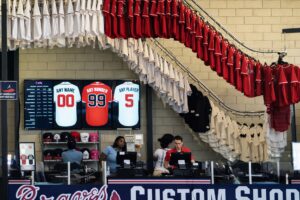
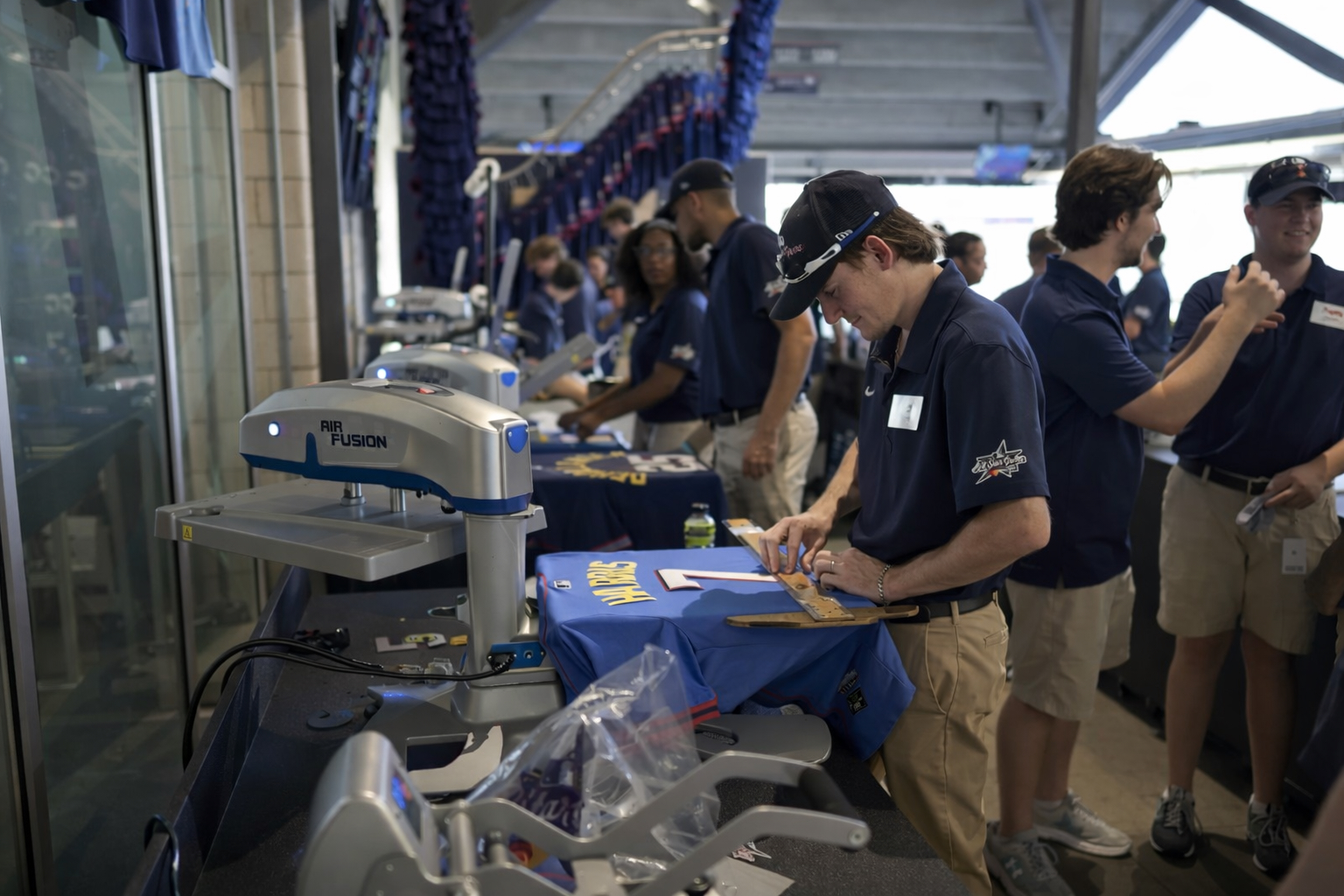
Live heat-press decoration has become a big part of the Atlanta Braves baseball experience. Photo courtesy of STAHLS’
At Coachella, The GAP brought this concept to life with its “GAP Hoodie House” activation, where festival goers were given a wide selection of patches to choose from to personalize a GAP hoodie of their choice. After they selected their patches, customers saw their creation come to life as the patches were applied before their eyes.
And The GAP wasn’t alone. Other Coachella activations, including Rivian’s brand experience powered by agency partner Are You Mad, offered similar customization experiences using upcycled bags and other accessories. Together, these activations demonstrate how personalization can be a meaningful revenue opportunity, particularly among younger consumers who value individuality and self-expression in the products they wear.
Personalization, of course, isn’t limited to Gen Z or fashion apparel. It has long been a major driver in markets like sports, where fans seek jerseys featuring their favorite players or their own names and phrases. What’s changed is the expectation around speed. In today’s on-demand economy, waiting weeks for custom apparel is no longer acceptable.
Forward-thinking organizations are responding accordingly by bringing production directly to the point of sale. Major League Baseball’s Atlanta Braves, for example, have reimagined their merchandise experience at Truist Park by adopting an on-demand model. During all 81 home games, fans can now watch jerseys being customized in real time, with on-site heat presses and dedicated staff turning blank garments into finished pieces within minutes.
Once again, this approach transforms personalization into an “experience.” Fans can choose a player’s name or create their own design, then watch it come to life right in front of them. The process itself becomes a draw, sparking curiosity, creating engagement, and turning a simple purchase into something memorable.
Multiple Types of Custom Apparel Activations
Offering live apparel printing doesn’t need to be limited to just hoodies and T-shirts. In fact, offering other items, like hats and premium upsells, can be a great way to set your activation apart. That said, before committing to a premium experience, you should consider your equipment, production capability and expected audience.
Standard T-Shirt Activations: On-demand T-shirt printing remains a popular activation for sports, festivals and live events where merchandise is sold. Offering a range of garment styles, colors and design options allows customers to mix and match to get their desired result. This model is especially effective for high-traffic events and serves as a reliable revenue driver as well as a practical entry point for testing custom apparel activations before investing in more specialized or premium experiences.
With relatively low setup costs and broad audience appeal, on-demand printing is highly scalable. Organizers can further increase profitability by offering premium upgrades, such as name or date personalization, specialty finishes or dimensional transfers, transforming a simple purchase into a more valuable, customized product.
Hoodie Customization Stations: A step up from basic T-shirts is offering hoodies as a premium alternative. Not only do they command a higher price point, but there are more opportunities for additional print placements such as the sleeve, hood, or pocket that can be offered as an upsell.
Hoodies also provide a stronger canvas for dimensional decorations like patches and emblems. With heavier construction and less frequent washing, they are better suited for thicker, more durable applications. This opens the door for premium add-ons like multi-location prints and specialty embellishments, appealing to a more fashion-forward audience while increasing overall transaction value.
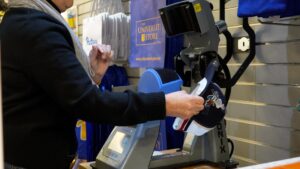
Hat bars like this one are another great way of interacting with customers. Photo courtesy of STAHLS’
Hat Bars: Hat bars have become one of the fastest-growing activation formats, offering decorators an opportunity to deliver premium products with higher profit margins. For events where there may be other vendors offering on-site T-shirt printing, hat bars are a great way to offer something different.
Customers can individualize their hats with standard transfers or add on emblems and patches for a premium look and price point. These embellishments offer unique textures and dimension compared to traditional embroidery, enhancing both the product and the overall experience.
With personalization completed in as little as 45 seconds, hat bars deliver a fast, interactive process that keeps lines moving while maximizing engagement.
How to Execute an Onsite Custom Apparel Activation
Planning your activation depends on your equipment capacity, expected attendance and available space. The type of transfer you choose also plays a key role, impacting both the result and the time required to decorate each item.
For high-traffic events, T-shirt or hoodie printing is often the most efficient option. These garments can be decorated quickly, allowing you to move customers through the line faster. Screen-printed transfers are ideal in this setting, since they’re cost-effective in bulk and offer fast application times. Direct-to-film (DTF) transfers can be introduced as a premium upgrade, enabling full-color, more detailed designs.
For smaller, more curated events, hat bars provide an opportunity to focus on a premium, higher-margin experience. To maintain efficiency, it’s best to stick to one primary decoration method—either transfers or emblems and patches. If you choose to offer both, use separate heat presses to avoid downtime caused by temperature adjustments. Another option is to pre-decorate select hats with base designs, allowing customers to personalize further by adding patches.
If your activation includes mix-and-match elements, such as patch customization on hats or hoodies, design cohesion is key. Curate patch collections that work well together so customers can easily combine elements while still achieving a polished look.
For pricing, you’ll want to offer a base model price to cover the cost of the blank garment, decoration and overhead. In addition, consider offering an à la carte model for additional print placements or customizations. Each print or patch can be charged by size, rather than type to keep pricing simple. As an example, smaller patches could start around $3, midsize patches at $5 and premium designs at $7.50.
Conclusion: So Many Reasons to Give Live POD a Chance
Print-on-demand apparel activations are a great way to cater to new audiences and stand out as an apparel brand by capitalizing on the sentimental value of customization.
When planning an activation, the apparel and transfer types you offer should align with both your target audience and your equipment capabilities. Your heat press should be portable, reliable, and versatile enough to handle a range of garment types and print sizes.
The most successful activations go beyond simply selling a T-shirt by creating personalized experiences that customers carry with them long after the event.
Dalaney Bradley is a veteran content marketing specialist with long-time custom transfer supplier STAHLS’ TXP Transfer Express (transferexpress.com) and heat-press manufacturer STAHLS’ Hotronix (hotronix.com).