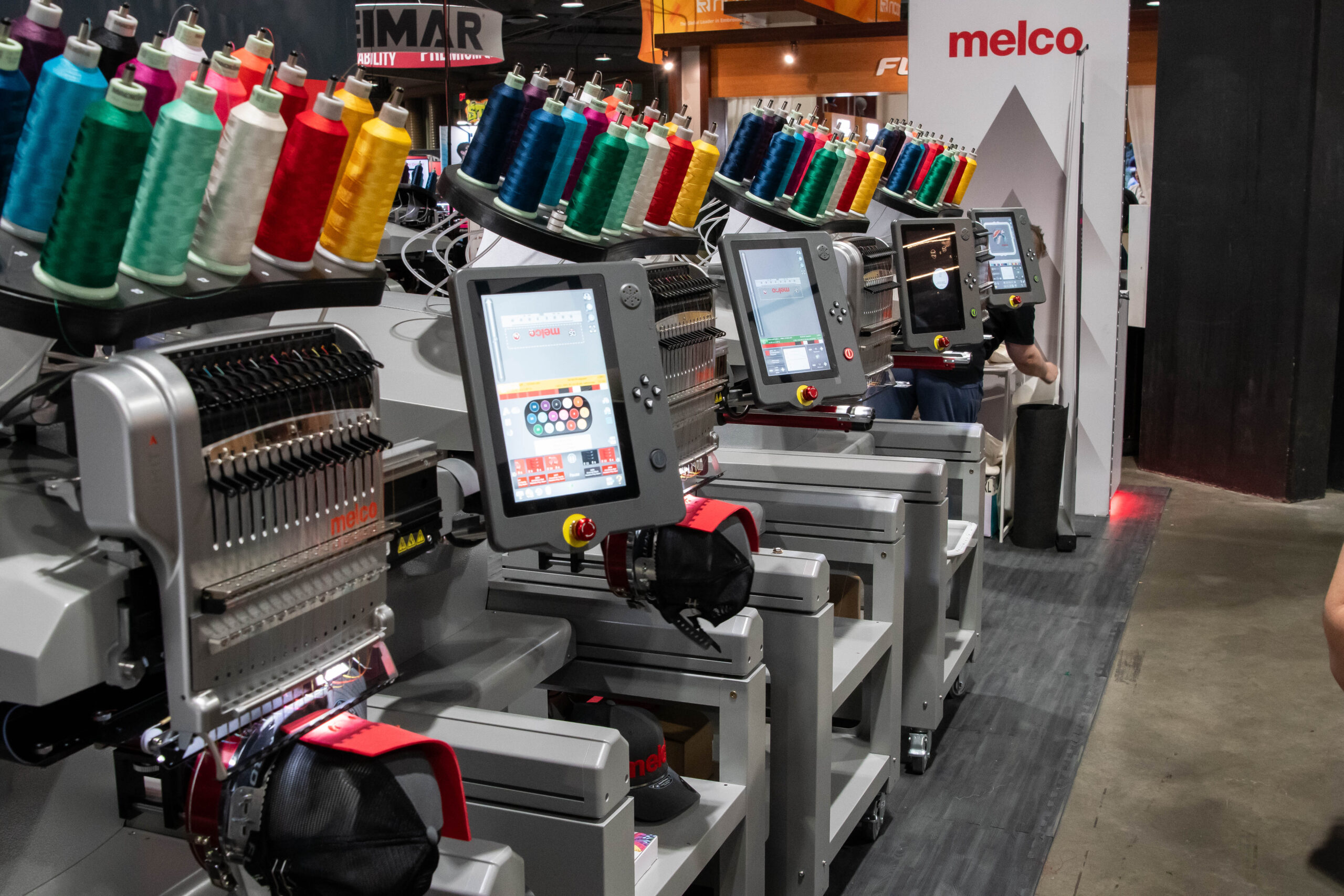
From corporate polo shirts and sweatshirts to custom hoodies and knit caps, today’s embroiderers are continually looking for ways to expand their product offerings. Meeting these demands requires more than just a creative eye. It also requires the right equipment.
If you have ever attended an industry trade show, like Impressions Expo, you invariably saw a range of commercial single-head and multi-head multiple-needle embroidery machines. Manufacturers are also regularly debuting innovative new pieces of equipment designed to speed up production and improve stitch quality. Navigating these options can feel overwhelming, especially when trying to balance your budget with your desired scale of operations.
Suffice it to say, every embroidery business operates under a unique set of constraints. A home-based embroidery business, for example, might operate out of a spare room or a garage. For these decorators, space is at a premium, and budget constraints play a major role in purchasing decisions. As a result, these kinds of shops typically start with one or maybe two single-head machines. Such models allow them to fulfill custom orders for, say, their local sports teams or small businesses groups without requiring a massive upfront investment.
Conversely, larger shops may decorate hundreds or even thousands of garments per day. These facilities cannot rely on a few single-head units. They require one or more multi-head machines running continuously to hit their deadlines and production goals. With this in mind, today’s high-volume shops prioritize maximum output and durability, investing heavily in machines that can embroider six, eight or more garments simultaneously.

Key Features to Consider in a Commercial Embroidery Machine
In terms of the many options available with today’s commercial embroidery machines, some of the more saliant features you are going want to consider include the following.
Number of Needles: The number of needles a machine has directly impacts the number of thread colors you can use at a time. Entry-level commercial machines often start with 10 needles. Stepping up to a 12-needle or 15-needle machine allows for much greater flexibility. Some advanced models, like the ZSK Sprint 7, feature 18 needles, while Ricoma offers machines with up to 20 needles.
Stitching Speeds: Machine speed is measured in stitches per minute (spm). Standard commercial machines typically operate between 1,000 and 1,200 pm, while some higher performance can reach speeds of 1,500 spm or more. Faster stitching speeds allow you to clear your production queue quickly, especially during seasonal peak periods. That said, actual stitching speeds will also be dictated by the kind of embroidery you are doing. Embroidering with specialty threads will often mean using lower stitching speeds to help avoid thread breaks, etc.
Sewing Fields: The sewing field determines the maximum size of the design you can embroider. Decorating the left chest of a polo shirt requires a relatively small sewing field. However, if you plan to embroider larger graphics on the backs of jackets or sweatshirts, you will need a machine with a much larger working area. Machines with larger sewing fields typically cost more—as will the hoops required to take full advantage of them—however, larger designs also mean more revenue and (ideally) higher profits.
User Interfaces and Control Software: Gone are the days of clunky, difficult-to-read machine displays. Today’s commercial machines feature highly sophisticated user interfaces. You will frequently find a 10-inch, full-color HD touchscreen that allows operators to preview stitches in real-time. Todays increasingly intuitive software often includes built-in lettering, design storage and a range of easy-to-navigate menus, drastically reducing the learning curve for new employees. For those apparel shops looking to branch out into embroidery, these technologies can be especially helpful. Note: this is an area in which it makes sense to visit a dealer or a trade show in order to try out a various different interfaces for yourself to see what works best.
Single-Head Embroidery Machines: Flexibility for Smaller Shops
Choosing between a single-head and a multi-head machine fundamentally changes how your shop operates. Single-head machines are incredibly versatile. They are perfect for small-batch orders, personalized items with individual names and complex one-off designs. Because they operate independently, a thread break on a single machine does not stop production on any others. They are also easier to maneuver and fit into tight workspaces. Their main disadvantage is production capacity. The process of fulfilling an order of 500 identical baseball hats on a single-head machine will be a tedious one, to say the least.
Multi-Head Embroidery Machines: Scaling High-Volume Production
Multi-head machines, on the other hand, are the undisputed champions of high-volume production. If you regularly land large contracts for, say, corporate apparel or a big customer like a university, a multi-head machine will increase your output exponentially. The disadvantage of a traditional multi-head system is that if, say, a thread breaks on head number three, all the other heads must stop while an operator fixes the issue. They also require a significant amount of floor space and a larger initial investment.
Embroidery Machine Networking and Production Management
As custom apparel shops grow, managing the flow of digital design files becomes a logistical challenge. Manufacturers have responded by integrating advanced networking capabilities into their control software. For example, instead of manually inserting a USB drive into every machine on the floor, a networked system allows operators to push designs directly from a central workstation, ensuring accuracy and saving valuable time.
Among the leaders in this area is the Melco SUMMIT platform, a system that makes it possible to link multiple single-head machines in a way that offers the best of all possible worlds, since in the event one of the machines gets in trouble, the others keep on stitching.
The machines manufactured by ZSK, Barudan, and Tajima offer a host of different networking tools as well. The results are systems that allow managers to track machine efficiency, monitor stitch counts and organize production queues in real-time. The high-level data analysis made possible by this kind of monitoring can in turn be invaluable in providing actionable insights to help shop owners identify inefficiencies and optimize their operations.
Commercial Embroidery Machine Manufacturers to Know
As is the case with much in the decorated apparel world, you get what you pay for when it comes to machine embroidery equipment. By purchasing from an established manufacturer, you not only increase your chances of getting a machine that is going to last, you gain access to the company’s expertise and backing in the event you run into any kind of trouble. What follows are a few of the industry’s major players.
Barudan: Barudan is well known for its heavy-duty, exceptionally durable machinery. The company offers a popular line of single-head models as well as a line of multi-head configurations including as many as 56 heads. Their machines are known for creating crisp, precise stitches on thick materials.
Melco: In addition to its aforementioned Melco SUMMIT system, Melco offers a wide range of single-head machines offering a host of innovative features with an eye toward boosting by quality and production efficiencies.
ZSK: German-engineered ZSK machines are synonymous with precision and dependability. ZSK’s slim tubular arms make it that much easier to embroider difficult items, like pockets and sleeves. The company’s 18-needle Racer R1W system can execute 2,000 stitches per minute given the right conditions.
Ricoma: A truly global company with manufacturing facilities in China and a well-established presence in the United States, Ricoma International offers a comprehensive lineup of machines catering to every shop size. The company has long focused on user-friendly technology and training for those getting started in the industry.
Brother USA: With a long-standing reputation for building reliable, accessible machines, Brother USA’s commercial multi-needle equipment is known for its intuitive interfaces, making it a favorite among small business owners and those looking to make a career out their home embroidery.
Tajima: Another global name, this time based in Japan, Tajima offers a product line that includes everything from a variety of top-quality single-head machines to a line of multi-head machines equipped with a dozen heads or more.
Avancé: Distributed by ColDesi, the Avancé brand focuses on making commercial embroidery accessible. With this mind, its compact 1201C and the heavy-duty 1501C system offer a combination of large touchscreens and high stitch speeds at a competitive price point.
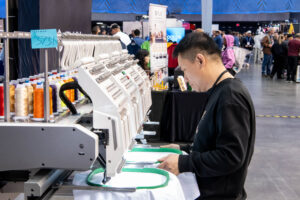
Hands-on equipment demonstrations allow decorators to evaluate commercial embroidery machines, including their controls, sewing fields and operation, before deciding which system best matches their shop’s production needs. Photo courtesy of Impressions Expo
Why Proper Hooping Matters in Commercial Embroidery
Something else to keep in mind when looking to invest a new embroidery machine: even the most advanced system will produce poor results if the garments being decorated are not hooped correctly. Hoops come in dozens of different sizes and shapes, including small rounds for left-chest logos, large rectangles for jacket backs and specialized cap hoops for the curved surfaces of baseball hats and other headwear.
One of the most significant innovations in the industry comes from HoopMaster and its line of Mighty Hoops. Traditional physical tension hoops require the operator to press a pair of rings together, which can cause hand fatigue and result in “hoop burn” on delicate fabrics. Mighty Hoops solve this problem by using powerful magnets that allow the rings to snap together effortlessly, securing thick items like winter jackets or heavy sweatshirts without stressing the operator’s wrists.