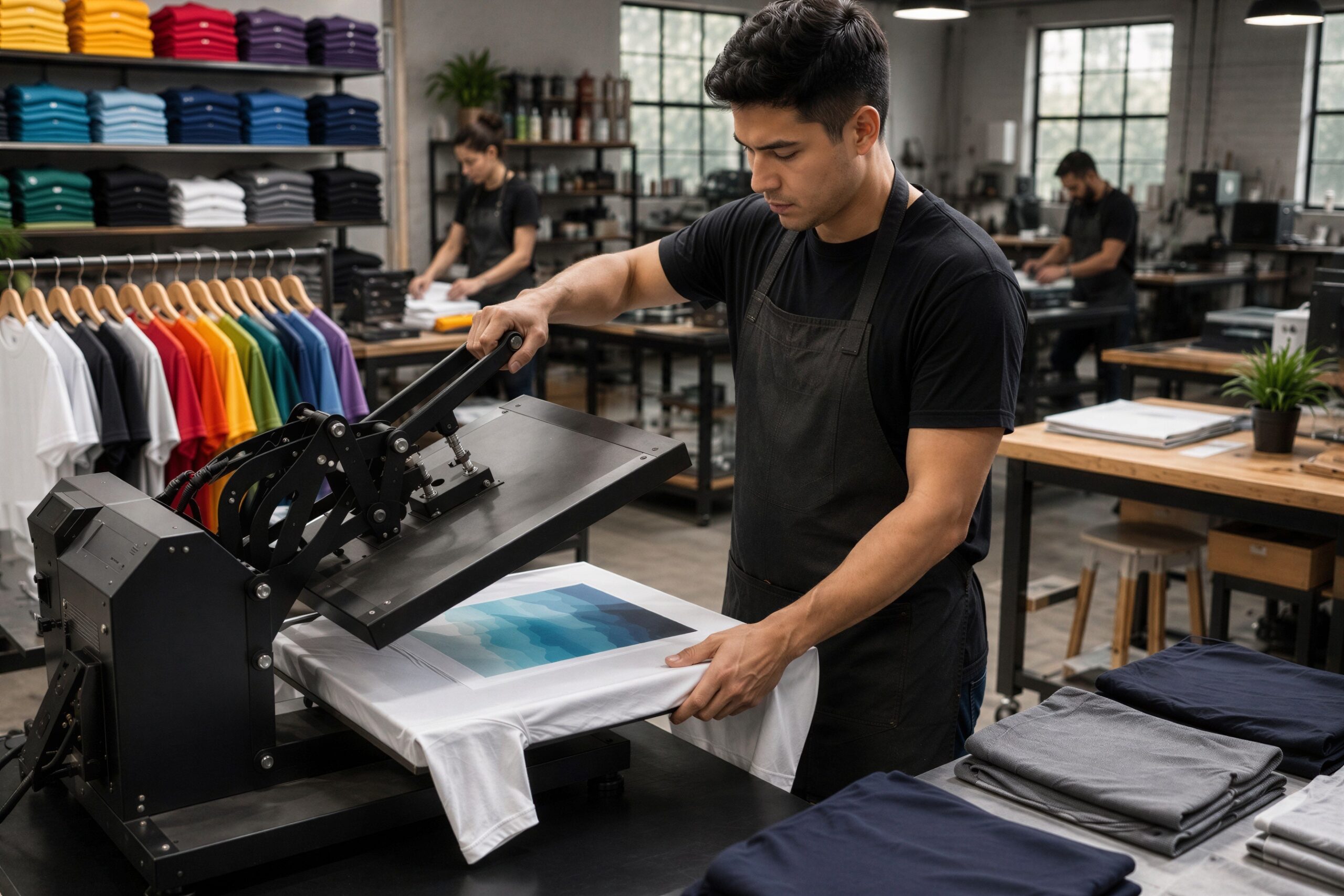
For years, the humble heat press occupied a straightforward place on the decorated-apparel production floor. Load a shirt. Position the transfer. Press it. Peel it. Repeat.
Simple enough, until you must do it hundreds or thousands of times.
The rapid growth of direct-to-film (DTF) decorating is changing that equation. Today’s commercial DTF printers can generate transfers at a rate that makes larger production runs increasingly practical, while improvements in transfer quality, durability and feel have helped DTF compete for jobs once automatically routed to screen printing. Impressions has previously reported, in The Tidal Wave that is Direct-to-Film (DTF) Apparel Decorating: Part 2 of 2, that the historical disadvantage DTF faced on larger runs has been narrowing as equipment and transfer technology improve.
That progress has created another challenge, though. A shop may be able to print transfers at impressive speeds, but somebody still must get those transfers onto shirts.

And when volume climbs, the heat press can become the bottleneck.
The industry’s response is a new generation of automated and semi-automated heat-pressing systems designed to increase finished-garment output without requiring a corresponding increase in operators. Brown Manufacturing’s Stomper Yet-Tee, ROQ’s IMPRESS ecosystem and the new Hotronix Carousel approach that challenge differently, but all three point toward the same future: heat pressing is increasingly becoming a true production line.
Why Labor Is Changing the Heat-Press Equation
Increasing capacity with conventional heat presses has historically been relatively straightforward: buy another press and put another operator in front of it.
Eventually, however, the math becomes less appealing.
Every additional manual pressing station takes up floor space and may require another employee. Beyond pressing the garment, operators may need to load and straighten shirts, position transfers, peel carriers, perform a second finishing press and unload finished garments. Multiply those touches by several hundred shirts and the labor requirement becomes significant.
That makes the relevant production metric more than simply shirts per hour. High-volume shops also need to consider labor hours per order and labor cost per finished garment.
The exact savings from automation will vary dramatically depending on wages, order mix, transfer type, workflow and equipment. But the underlying principle is simple: if a shop can produce more finished garments with the same number of people, the labor component of each shirt can potentially decline.
Automation can also address something less easily captured on a spreadsheet: repetitive work. Heat pressing hundreds of identical shirts means performing essentially the same motions throughout a shift. Automating positioning, pressing, peeling or unloading allows employees to spend less time on those repetitive tasks and more time loading, quality checking, packaging or managing production.
For shops struggling to hire and retain production employees, that can be nearly as important as raw speed.
DTF Grows Up Into Bigger Orders
Automation’s arrival also says something about how dramatically DTF itself has evolved.
DTF initially made its mark as an extraordinarily flexible option for short runs, detailed multicolor artwork and jobs where screen-printing setup wasn’t economical. It remains excellent at those things.
But the technology is no longer confined to them.
Faster commercial printers, automated powdering and curing, gang sheets, improved transfer materials and increasingly sophisticated production software have helped make higher volume DTF more practical. Impressions has documented this shift repeatedly, including the growing ability of DTF to tackle larger orders traditionally associated with screen printing.
The result is a production imbalance shops didn’t necessarily have when DTF volumes were lower.
Imagine a printer generating transfers faster than operators can apply them. Making the printer even faster doesn’t solve the problem. It simply creates a bigger stack of transfers waiting beside the heat press.
At that point, pressing, not printing, determines the shop’s actual capacity.
This is where automated heat pressing begins to make sense.
ROQ IMPRESS Brings the Automatic-Press Model to DTF
Few machines illustrate the transition from manual heat pressing to production-line heat pressing as clearly as the ROQ IMPRESS.
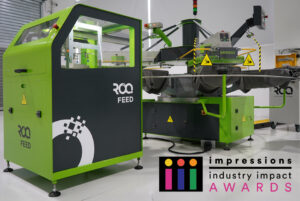
The ROQ IMPRESS. Photo courtesy of ROQ
ROQ approached the problem from a familiar direction. The company has extensive experience manufacturing automatic screen-printing equipment, and the IMPRESS essentially applies the multi-station automatic-press concept to heat transfers.
The six-station IMPRESS is available with two heat presses for production of up to 300 pieces per hour or three heat presses for output of up to 500 pieces per hour. It can work with DTF, Supacolor, screen-printed transfers, vinyl and specialty transfers.
Those numbers are significant, but perhaps more important is what ROQ has built around the press.
The company’s complementary FEED, PEEL and PULL systems automate additional steps surrounding transfer application. FEED positions transfers, PEEL removes the carrier after pressing and PULL removes the decorated garment. With those systems incorporated into the line, the primary manual task left to an operator is loading the garment onto the platen.
The system can also store customized production “recipes,” making it easier to reproduce settings for repeat jobs.
This is where automated heat pressing begins looking less like a faster version of a conventional press and more like an automatic screen-printing production philosophy adapted for transfers.
That distinction matters. A decorator considering automation isn’t simply asking, “How quickly can this platen heat a shirt?” The larger question becomes, “How many manual steps can I remove from the entire application process?”
Brown Manufacturing Pushes Toward Single-Operator Production
Brown Manufacturing Group takes the concept another step with its Stomper Yet-Tee system, winner of the 2026 Impressions Industry Impact Award for Best New DTF System.
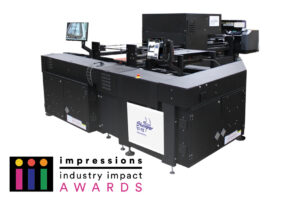
Brown Manufacturing Stomper Yet-Tee. Photo courtesy of Brown
Brown describes the concept as “single operator full production.”
The operator loads the garment, scans a barcode identifying the appropriate design and starts the process. From there, the Yet-Tee handles printing, curing, heat pressing and peeling the transfer carrier from the decorated garment.
The system is available in a larger-capacity “T” configuration and smaller-capacity “L” configuration and is intended to accommodate both very small orders, including individual items and larger production runs.
That flexibility highlights another reason automation is becoming so important.
Modern shops aren’t necessarily choosing between high-volume production or print-on-demand. Increasingly, they’re expected to do both.
A customer may place a 500-piece order in the morning while an e-commerce store generates individual personalized orders throughout the afternoon. Equipment capable of automating production while responding to barcode-driven job information offers a way to accommodate both workflows without constantly rebuilding the production floor around each order.
The Yet-Tee therefore represents more than labor savings. It demonstrates how automation, DTF and digital job information can begin converging into a connected production workflow.
That direction is continuing to develop. DuPont recently announced demonstrations pairing Brown’s Yet-Tee automation platform with its Artistri powderless DTF consumables, an approach intended to reduce manual production touchpoints from printing through finishing.
Hotronix Carousel Targets the Pressing Bottleneck
The recently introduced Hotronix Carousel Heat Press from STAHLS’ approaches high-volume production around a continuous, multi-station workflow.
Instead of the stop-and-start process associated with a conventional heat-press station, garments move through multiple stations arranged around the central pressing equipment. This allows different production steps to take place within the same cell while reducing garment touches.
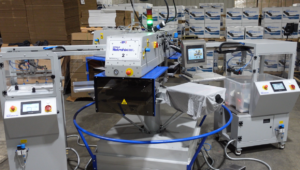
The Hotronix Carousel Heat Press. Photo courtesy of STAHLS’
STAHLS’ specifically positions the system as a way for high-volume apparel decorators, contract printers and fulfillment operations to increase capacity without simply adding more operators.
“As decorators expand production capacity, adding more presses and operators is not always the best path forward,” Josh Ellsworth, chief revenue officer at STAHLS’, said when the system debuted. “The Hotronix Carousel provides a smarter way to increase production by combining an efficient continuous workflow with the trusted performance of Hotronix heat press technology.”
That distinction illustrates an important point about heat-press automation: not every solution needs to automate every task. For some operations, the biggest improvement may come from reorganizing how garments flow between stations, minimizing idle time and allowing one operator or production team to keep multiple garments moving simultaneously.
In other words, workflow automation can matter just as much as machine automation.
Consistency Is Part of the Automation Story
Labor and speed may grab the headlines, but automated pressing offers another potential advantage: repeatability.
A transfer requires the correct combination of time, temperature and pressure. Placement needs to remain consistent from shirt No. 1 to shirt No. 500.
Experienced operators can deliver excellent results manually, but repetitive production inevitably introduces opportunities for variation. Employees get tired. New workers require training. Placement can drift. Dwell times can change when production gets hectic.
Automation doesn’t eliminate the need for process control, but once a system has been properly configured, it can help repeat the same production sequence garment after garment.
That becomes increasingly valuable as DTF moves into contract decorating, fulfillment and other applications where hundreds of garments may need to match.
It also changes the employee’s role. Instead of physically controlling every step, operators increasingly oversee the process—loading garments, monitoring quality, replenishing transfers, responding to exceptions and keeping the workflow moving.
When Does Automated Heat Pressing Make Sense?
For all its advantages, automation isn’t automatically the right investment for every shop.
A decorator producing a handful of transfers each day may be perfectly well served by a quality manual, auto-open or pneumatic press. Even shops handling substantial DTF volume may have such a varied order mix that multiple independent presses provide greater flexibility.
The case for automation becomes stronger when pressing consistently limits production.
Warning signs can include transfer stacks accumulating faster than they can be applied, multiple employees spending most of their shifts at presses, overtime during large orders, difficulty maintaining placement consistency or an inability to increase output without adding another press and another operator.
At that stage, shops should look beyond the purchase price of automated equipment and calculate the cost of the workflow they already have.
How many employees touch each order? How many garments does the pressing department actually finish per hour? What is the labor cost per finished shirt? How much floor space is devoted to multiple presses? How often is the printer waiting on the pressing department or vice versa?
Most importantly, shops should measure finished garments, not theoretical machine speeds.
A printer capable of generating hundreds of transfers an hour isn’t producing revenue if those transfers are sitting in a pile.
From Heat Press Station to Production System
The broader story isn’t that the manual heat press is disappearing. Far from it. Manual and semi-automatic presses will remain invaluable for short runs, specialty applications, sampling and shops whose production volumes don’t justify greater automation.
What’s changing is the ceiling.
DTF has given decorators a digital process capable of handling an enormous range of artwork, garment types and order quantities. Now equipment manufacturers are attacking the labor-intensive application stage that has historically limited how efficiently that flexibility scales.
ROQ’s IMPRESS demonstrates what happens when automatic screen-printing principles are applied to heat transfers. Brown Manufacturing’s Yet-Tee shows how barcode-driven automation can connect digital printing, curing, pressing and peeling. The Hotronix Carousel focuses on keeping garments moving through a continuous multi-station workflow.
Different machines. Different approaches. Same fundamental problem.
The faster DTF becomes, the less sense it makes for the rest of the production line to stand still. And for high-volume decorators, the next major productivity gain may not come from printing another transfer faster.
It may come from figuring out how to press it.