Commercial direct-to-film (DTF) printers range from compact entry-level models to high-speed production systems. The right machine depends on your shop’s size, budget, existing workflow and production volume. Outsourcing a shop’s transfers remains a viable option as well until in-house printing becomes cost-effective.
DTF printing has become one of the most disruptive technologies in custom apparel decoration. Screen printers, embroidery shops and promotional merchandise suppliers are all paying attention, and for good reason. DTF transfers bond to virtually any fabric with a simple heat press, produce vivid full-color prints and eliminate the setup costs associated with embroidery or screen printing. Once you’ve decided DTF is right for your business, though, a new question arises: do you want to outsource your transfer production, or print your transfers in-house, and if the latter, which machine makes the most sense?
The commercial DTF printer market has expanded rapidly with machines now available at nearly every price point and production speed. A shop producing a few hundred transfers a week, for example, has completely different needs than those of a large-scale operation running tens of thousands. A screen printer looking to add DTF as a complementary service faces different constraints than a heat-press decorator building a DTF-first business from scratch. Budget, floor space, technical experience and production goals all factor into the decision.
How Does Commercial DTF Printing Work?
Understanding the DTF printing process helps clarify why certain machine features matter. The process begins with a digital design, which is printed onto a special PET (polyester) transfer film atop a white ink base layer. While the ink is still wet, hot-melt adhesive powder is applied to the printed surface, after which the film passes through a curing oven, where the heat melts and fuses the adhesive to the ink layer, creating a durable, flexible transfer.

To apply the finished transfer to a garment, the decorator lays it ink-side down on the fabric and uses a heat press at approximately 300 to 320 degrees Fahrenheit for about 10 to 15 seconds. The adhesive activates under heat and pressure, bonding the design firmly to the fabric fibers.
With this in mind, every system requires two additional components: a powder shaker and a curing oven or dryer unit. Some manufacturers sell these as separate components; others bundle them into an integrated all-in-one system.
The powder shaker evenly distributes hot-melt adhesive powder across the freshly printed film, then removes the excess. This process must be consistent; uneven powder application produces weak adhesion or patchy print quality. Integrated powder shakers with automated recirculation systems recover unused powder for reuse, reducing waste and operating costs.
As for the curing oven, temperature consistency is what matters here: too little heat leaves the adhesive poorly bonded; too much can scorch the film or degrade ink quality. Fume extraction is another consideration. The curing process releases fumes from the adhesive powder, and adequate ventilation or an integrated filtration system is necessary for a safe working environment. Some machines include an integrated fume extractor as a standard feature.
Note: it’s also possible to apply the powder by hand and then cure with a heat press. However, this makes the process far more labor-intensive.
Again, one of DTF printing’s strongest selling points is its versatility. Unlike sublimation, which requires polyester-heavy fabrics, or direct-to-garment (DTG) printing, which struggles with dark garments and certain synthetic blends, DTF transfers work on nearly any apparel or textile substrate. Common decorating applications include:
• T-shirts and tank tops: cotton, polyester and blended fabrics in any color
• Hoodies and sweatshirts: including areas that are difficult to screen print, such as seamed panels
• Baseball hats and caps: structured and unstructured styles, applied with a hat press
• Bags and totes: canvas, polyester and nylon
• Patches: gang-printed on DTF film, then cut and applied to jackets, hats or bags
• Promotional merchandise: koozies, mouse pads, fabric-covered items and soft goods
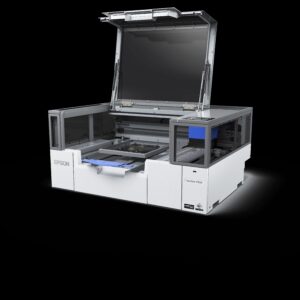
The compact Epson SureColor F1070 is shown with its top cover open, providing a view of the printer’s interior and garment platen. Photo courtesy of Epson
Key Features to Consider When Choosing a Commercial DTF Printer
Print Width and Film Handling: Commercial DTF printers are rated by the maximum width of PET transfer film they can handle. Most mid-range commercial machines work with 24-inch-wide film, which accommodates standard adult shirt front graphics with room for gang printing smaller designs side by side. Wider machines, such as the Epson SureColor G9070, can handle film up to 64 inches wide, enabling significantly more designs per linear foot of film and higher throughput.
Roll-to-roll film handling is a must for continuous production. Machines with automatic tension control systems, often called dancer systems, maintain consistent film feed without manual adjustment, reducing operator involvement and minimizing the risk of misregistered prints.
Print Heads and DTF Printing Speed: Print heads are at the heart of any DTF printer, and their number and technology directly affect both speed and print quality. Entry-level machines may use a single print head, while mid-range and high-production models use multiple heads configured to print CMYK and white ink channels simultaneously.
Speed is typically expressed in linear feet per hour. Entry-level machines produce 25 to 40 linear feet per hour. Mid-range machines produce 45 to 100 linear feet per hour. High-production systems push 150 to 275 or more linear feet per hour. For context, a standard 8-by-10-inch shirt front graphic requires roughly 10 to 12 inches of linear film, so a machine running 100 linear feet per hour can produce approximately 100 large shirt fronts per hour.
Color Gamut and Ink Systems: Standard DTF printers use a CMYK plus white ink configuration. White ink serves as both an underbase and an opaque layer, enabling prints on dark garments. CMYK alone can’t reproduce bright colors on black or navy fabric without it.
More advanced machines add a gamut of additional ink channels. The M&R Quatro 68, for example, uses Orange, Red, Green and Violet inks in addition to CMYK and White, producing a noticeably wider color range, particularly for saturated reds, oranges and greens that fall outside standard CMYK gamut. This matters for sports teams, brand logos and designs with demanding color accuracy requirements.
White ink recirculation systems keep white ink agitated and flowing to prevent the pigment from settling and clogging print heads, a common maintenance challenge with DTF printers.
Automatic Maintenance and Nozzle-Clog Prevention: Print head clogs are the primary source of downtime and print-quality issues in DTF printing. White ink is particularly prone to settling and clogging nozzles if the printer sits idle for extended periods.
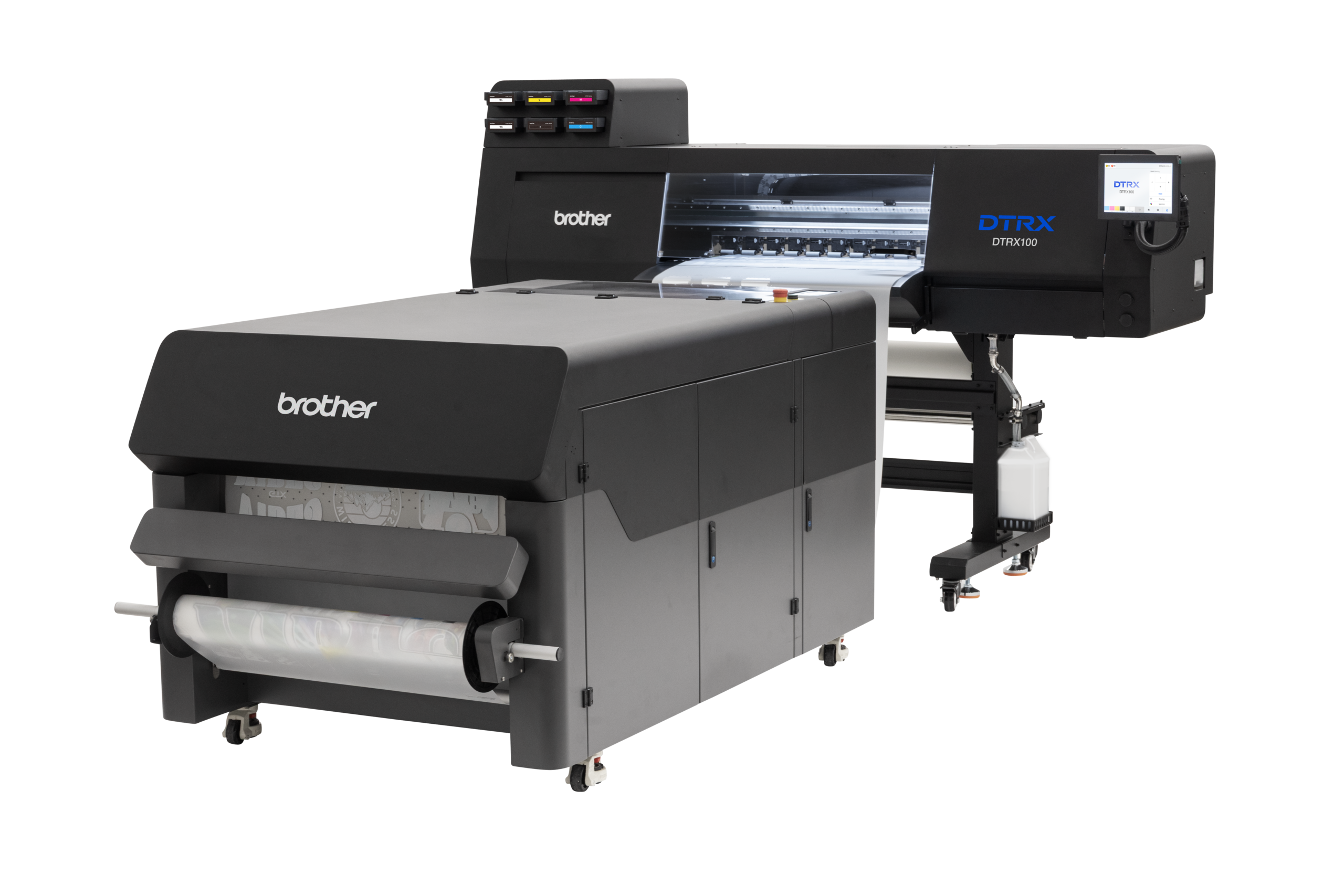
Look for machines with automated maintenance stations that perform periodic nozzle cleaning cycles, white ink recirculation and head-capping routines without operator intervention. The Epson SureColor G6070, for example, uses Epson’s PrecisionCore Micro TFP print head with Nozzle Verification Technology, which actively monitors nozzle health and compensates for blocked nozzles. Similarly, the Brother International DTRX 100 is specifically configured to facilitate ease of upkeep in order to ensure the printer continues to work it best over the course of even the longest production runs.
DTF Printer Footprint and Shop Space Requirements: Production space is a real constraint for smaller shops. A full DTF system, including the printer, powder shaker and curing oven, requires more floor space than many decorators expect. The M&R Quatro, for example, requires a minimum 10-by-8-foot working area, with 12-by-10 feet recommended.
Entry-level integrated systems, like the ColDesi DTF 12H2 at approximately 81 inches total combined length, or the DTF 19H2, which fits through a standard 36-inch door on wheels, are designed with smaller shop footprints in mind. If your production space is limited, confirming the combined installed dimensions of the printer, shaker and oven before purchasing is essential.
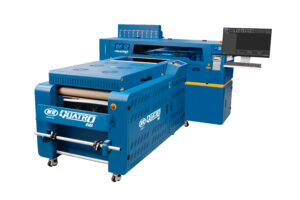
The M&R Quatro 68 commercial direct-to-film printing system is designed for high-volume DTF transfer production, combining expanded-gamut color capabilities with an integrated production workflow. Photo courtesy of M&R
Should You Print DTF Transfers In-House or Outsource Them?
Shops already decorating with heat presses don’t necessarily need to own a DTF printer to use DTF transfers. Third-party transfer suppliers, including Ninja Transfers, STAHLS’ Transfer Express and Versatrans, sell ready-to-press DTF transfers on demand, often with no minimum order quantities.
Outsourcing makes sense when:
• Your monthly transfer volume is low
• Your order sizes are small and unpredictable, making it difficult to justify per-print costs at machine capacity
• You don’t yet have the budget for an in-house system, including supplies, maintenance and operator time
• Your existing workflow doesn’t require same-day or next-day turnaround
In-house printing makes more financial sense when:
• Your monthly production volume is consistently high enough to recover machine costs within a reasonable time frame (typically 12 to 24 months)
• Turnaround time is a competitive advantage, and you can’t wait for outside suppliers
• You want full control over print quality, color matching and production scheduling
• You’re already operating a screen-printing shop and DTF fills orders that fall below your minimum screen-print quantities
The math is straightforward. A third-party gang-sheet transfer typically costs $1 to $3 per standard shirt-front design depending on
supplier, order quantity and size of the design. In-house production costs drop significantly at scale, particularly on higher-speed machines where per-print material costs for ink, film and adhesive can fall well below $0.50 per transfer at volume. Factor in equipment amortization, maintenance, operator time and supplies, and the break-even point becomes clearer.
For a screen-printing shop, DTF also opens order categories that screen printing can’t address economically: single-piece runs, short-run jobs with many colors and designs requiring soft-hand finishes on fabrics that won’t take ink well. That additional revenue stream can justify the investment even before the per-print economics fully tip in favor of in-house printing.
How to Choose the Right DTF Printer for Your Shop
The right DTF printer isn’t the one with the most features; it’s the one that matches your current production reality and leaves room to grow.
Start with an honest assessment of your monthly transfer volume. If you’re outsourcing transfers today, pull your invoices and calculate how many transfers you’re buying each month. Map that against the per-print costs of operating a machine at the capacity you’d realistically use, not peak-rated speed.
Whichever direction you go, test print quality against your actual job types before committing. Expanded gamut systems like the M&R Quatro 68 will matter more to shops with demanding color accuracy requirements. Compact footprint and ease of use will matter more to a one- or two-person operation. Technical support availability after the sale matters to everyone.
DTF printing has proven its durability, versatility and cost-effectiveness at commercial scale. The question now isn’t whether it belongs in your shop; it’s which system gets you there most efficiently.